

Larson is charged with one count of felony stalking and has pleaded not guilty. His attorney, Sara Christensen, has told the court the allegations are unproven and that it isn’t clear whether his writings describe things he actually did. This account comes from the sworn criminal complaint filed in Dane County on August 18, 2026, four days after detectives searched his house, and quotes his own letters and journals as they appear.
One night Benjamin Larson got into his car in Fond du Lac and drove ninety minutes southwest.
It was June 2025. She had been out of the country for twelve years. Nobody has explained how he knew she was back.
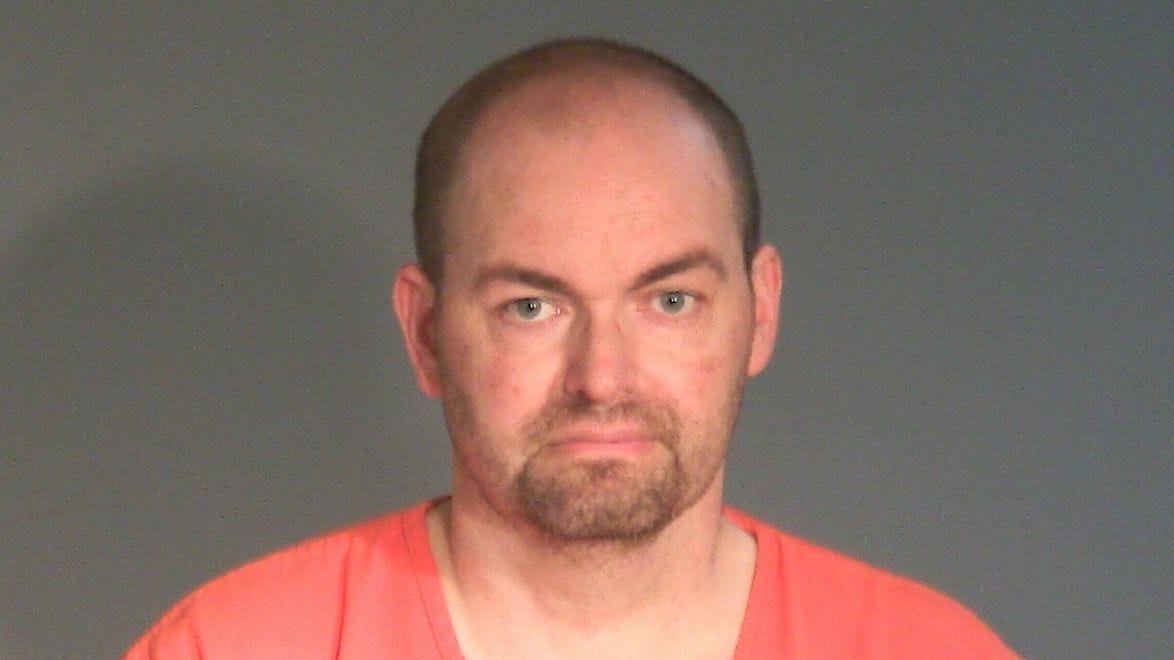
forty-seven-year-old Benjamin Larson
One night he got into his car in Fond du Lac and drove ninety minutes southwest.
He played music loud on the way down and wrote later that he was high on adrenaline the whole time. As it got dark, he turned down the music and drove through the streets of Madison thinking about how she had no idea he was coming. He later wrote that the thought made him feel giddy.
He found her street. He found the house. He circled the block one way, then circled it the other. He wrote that he felt like a shark, investigating its unknowing prey. Then he came back, turned off all his lights, and slowed to a stop just past her house. He shut off the engine.
He was dressed in black, including black gloves and a black mask.
He sat in the car, perfectly still. He wrote that he was barely breathing. He used two words for what he was doing there. Watching. Hunting.
The machete was already in the car. He kept one there. He wrote that reaching for it wasn’t part of the plan, that he grabbed it just for fun, and that it was a rush to think about where he was sitting: not fifty feet from where she was, machete in hand.
He stayed a long while.
Then he got out, walked up her driveway, and wrote down the make, model, and plate number of her car. He pulled three bags of garbage out of her bin. He got back in and left as silently as he had arrived.
She was inside. He wrote afterward that she had no idea what had just happened. He kept his writings in a black portfolio in a basement dresser, part of twenty-five handwritten pages about a woman he had dated for two months in 2013.
It had been easier than he thought, he wrote. And ever since, he had wanted the feeling again.
Then he gave the entry a heading. He filed it under “Add on – Happiness.”
Two Months in 2013
They met because of a party trick.
Two friends of hers drove out to Benjamin Larson’s place in Fond du Lac so he could make body casts of them. She went along.
His hobby was making permanent copies of other people’s bodies.
They went for coffee at Michelangelo’s in Madison. Somewhere in that first conversation, he told her he was in a lonely and loveless marriage.
She dated him for about two months in the spring of 2013. She would later tell detectives she saw him a handful of times. She lived in Madison. He lived seventy miles north.
She described the relationship as “very intense.” Over the course of it, he told her about his obsession with Ed Gein, the Plainfield farmer whose house Wisconsin has never quite gotten over, and about death, and about gore.
She ended it in June, after he called her and told her he was suicidal with a gun to his head.
That was the whole relationship. Two months, a few dates, a disclosure about a bad marriage, an obsession with a dead grave robber, and a phone call that put his life on her. She left anyway.
Everything that follows happened after she stopped seeing him.
He Told Her It Took Him Thirteen Years to Get Over the Last One
She moved to Canada in the fall of 2013 and didn’t give him her address.
Letters started arriving at her mother’s house in Madison. Three or four of them, addressed to her. Her mother eventually found gifts he had tried to send, too. Then emails.
In August of 2015, one of those emails was fifteen pages.
He had gotten “their symbol” tattooed on himself, along with her initials, “now a part of my living body.”
He also told her it had taken him thirteen years to get over his first girlfriend, and that he still thought about her. He was two years into pursuing a woman he had dated for two months. He offered this as proof of how deeply he feels things.
Then he told her what he had kept:
Every single word she ever wrote to him. A Ziploc bag of polished stones and a stone wire wrapping kit, one stone crudely wrapped. A Tibetan cross she had slipped into his pocket. A lone earring, still tangled with her hair. Two pieces of scrimshaw. A pressed blue scilla. A coin dated 1984 she gave him during a hard time. A blank shell necklace, ready for engraving. Two cards. One surviving voicemail, her voice telling him she loves him and will always be there for him, that he can always count on her, that he will never be alone again.
And the desiccated remains of a white rose, which he told her was perhaps the most symbolic of all.
Some of what he listed, she had given him. A Tibetan cross slipped into his pocket. A coin from 1984, handed over when he was having a hard time. A shell necklace she bought him, blank, ready for engraving. A voicemail telling him he would never be alone again.
That is what she was like, in two months, to a man she had gone out with a handful of times.
Around that list he wrote:
“Here or not, [she] is permanent with me, never to go away now. Even if you do decide to leave my life, and never look back on me again for the rest of your days, you will still be with me. As much a part of me as my own flesh and bones now. It simply is. There is nothing that will, or could, change this.”
And:
“When you said that I meant something to you, and that you would love me forever, I believed this. I wasn’t aware, however, that the time period for forever was subjective.”
She never answered. By 2015, he was already telling her that it didn’t matter.
What He Was Actually Asking For
Benjamin Larson never asked her to come back. Three times over ten years, he told her directly what he wanted from her, and not once was it a relationship.
The assumption about a man who pursues an ex for thirteen years is that he wants her back. That's the spurned lover, the man who can't accept no. The clinical version is similar. In the typology developed by Paul Mullen and his colleagues in Australia, a man like this is a rejected stalker, someone seeking reconciliation or revenge or some mix of the two after a relationship ends. Larson was after neither.
The risk profile that comes with that label fits him. What the label says he wants does not.
He repeatedly asked for the same thing in his own documents.
In 2015: that she know he still exists. He is sending her gifts and messages, he writes, “letting you know I am still here. Alive. Waiting.”
In November of 2025, on a handwritten card sent to her office: “By now it’s very apparent that you don’t wish to talk to me.” He wants to know why she didn’t want to respond. And then: “As I am not one who gives up easily, I will continue to try contacting you until I hear something from you.”
In the complaint he filed against her professional license with the Wisconsin Department of Safety and Professional Services, he says that she keeps refusing to contact him for “closure,” and that he will “continue this endeavor as long as is necessary.”
Every one of them asks for a response. Thirteen years of escalating conduct in service of a single demand: say something.
Reconciliation doesn't explain the rest. She left the country, and he kept writing. She never answered. In 2015, he reminded her he was still here, alive, waiting. Ten years later, he was still telling her the same thing: that he was not one who gives up easily and would continue until he heard something.
He had told her on their first date that he was married. Whatever he wanted from her, a partner was not it.
The only response he ever got, he wrote himself.
He spent the next decade building machinery to force a single word out of a woman who had decided never to give him one.
The Years He Was Not Contacting Her
After 2015, she didn’t hear from him for ten years.
She moved back to Madison.
Her mother was still there. She had a husband by then, and a child, and a career of her own, and ten years of quiet behind her. Coming home was a bet that it was over. Against almost any man alive she would have been right. She had been gone twelve years.
He started again in November 2025. By then someone else had been in touch on his behalf for five months.
In his basement, investigators found a black garbage bag. Larson told them anything of hers would be in there. Inside, among other things, were four napkins or paper towels with dried blue flowers pressed inside them.
Each one had a year written on it.
2014. 2015. 2017. 2019.
During the decade when this woman believed he had finally moved on, when she was living in another country, building a marriage, having a child, doing the ordinary work of a life he was no longer part of, he was pressing flowers and dating them, the way you maintain any collection you expect to keep.
The only thing that stopped in 2015 was contact.
When we say a stalker has stopped, we almost always mean the woman stopped hearing from him, because that’s all she can observe. Sometimes the pursuit actually ends; the man got better, got help, or moved on to someone else. Sometimes it stops because he lost track of her. The pressed flowers show us which explanation fits here.
He had written in 2015 that she was as much a part of him as his own flesh and bones, and that nothing could change that. He had put her initials into his skin. She was in Canada, and he had no address for her, no office to send anything to, no street to drive down. Then she came home.
She became reachable again in 2025.
Netflix released its Ed Gein series in October of that year, weeks before the first card arrived at her office. His preoccupation with Gein predated it by at least twelve years. The series did not put Gein in his head. It put him on everyone else's television.
“Season’s Creeping”
The first card came handwritten, to her business office in Dane County. He wanted to catch up. He wanted to know what had made her not want to respond. He was not, he wrote, a man who gives up easily.
Then: “I’m not sure if I need to try calling, or just knock on your door someday, or what.”
The second card came in December, and it did not go to her office.
It was a Nightmare Before Christmas holiday card, with a phrase printed on it. Season’s Creeping.
Inside the card, signed BEN, was a typed letter. He had been wandering around Madison, he wrote, as part of his therapy, and he thought he might run into her.
“That would be a memorable encounter, surely… I’ll keep my eyes open.”
He closed by naming her husband and her child.
In the twenty-five pages: “I hate that they have a life together… That the child she promised me is his.”
He had dated her for two months in 2013. Somewhere in the years after that, he convinced himself she had broken a commitment.
She and her husband had been careful never to post anything about their child online.
She had never given him her home address. It was on the envelope.
Eight months later, in a dresser drawer in his basement, investigators found three more cards. Blank.
He Made Himself Her Patient
Five months before that first card arrived, someone else had already made contact.
Benjamin Larson was seeing a trauma therapist. She is a licensed clinician.
The card she sent in June of 2025 was a Hallmark card. It said she wanted to speak about his individual trauma therapy.
Larson’s therapist tried again in July, through Psychology Today. The woman she was contacting is a therapist herself, with a profile on the platform. A therapist has to be accessible. The directory exists so that someone in trouble can look up a professional and get help. Larson's therapist used it to ask her to "converse" and share her thoughts about a man she hadn't spoken to in twelve years.
In August, Larson’s therapist left a voicemail. She said some things about him concerned her, and she really wanted to make contact so she could resolve these issues as fast as possible. The woman never responded. Detectives later confirmed the contacts had come from his therapist.
Three approaches in three months, through three separate channels, from a licensed clinician to a woman whose only connection to the patient was that she had gone out with him a few times in 2013. She had no information about his treatment. She was not a collateral source. She was a short-lived and long-ago girlfriend.
A woman who had kept her distance for twelve years suddenly had Benjamin Larson in her mail, in her professional listing, and on her voicemail, carried there by someone with credentials.
Larson later told police that his therapist had informed him that licensing complaints would get her to respond, and that this was why he filed them.
Larson did file them, in Wisconsin, in Oregon, and in North Carolina, against a woman who had never been his therapist. He alleged she was lying about how many years she had been practicing. He alleged she continued to refuse to contact him for closure on a relationship that had ended over a decade earlier. He explained that he had been in therapy for more than ten years because of their sudden separation, that her conduct had shown the person she truly is, and that he would continue to complain as long as it was necessary.
He couldn’t make her answer a letter. So he filed a document that a state agency is obligated to process against the license she needs to earn a living, in a proceeding where she has no choice but to respond.
He had found the one context in which a woman who would never speak to him again would be required to respond. Not to him, but about him. Under her own name, in writing, to a board.
Both avenues he used were for another purpose. The directory is there so clients can find the right therapist. The board, so someone a therapist has harmed can be heard. He used them in that order.
And the substance of the complaint is a client’s grievance. She lied about her credentials. She refuses to give me closure. He had never been her client, but the document he filed is the document an abandoned client files.
There is a version of this in which Larson’s therapist is doing something defensible. Wisconsin has recognized since Schuster v. Altenberg in 1988 that a clinician can be held liable for failing to act when a patient poses a foreseeable danger to someone else. The rule is court-made rather than statutory, and Wisconsin’s version reaches further than most. Other states limit the duty to a clearly identifiable victim. If a trauma therapist listening to Benjamin Larson had concluded that this woman was in danger, reaching her would have been defensible.
A warning would have named the danger. It would have said: my patient may hurt you, take precautions, here is who to call. The card asked to speak about his individual trauma therapy. The message through Psychology Today asked the same. The voicemail said there were things about him that concerned her and that she wanted contact so the issues could be resolved as fast as possible.
That is not what the three contacts did. Every one of them asked her to take part in his treatment. The card wanted to speak about his individual trauma therapy. The message through Psychology Today wanted her thoughts on the matter. The voicemail wanted contact so that issues about him could be resolved. A clinician protecting a woman from her patient does not ask the woman to help with the patient.
Then there is what happened when she didn’t answer. A therapist discharging a duty to protect, met with silence, calls the police. This one tried again, and then a third time, across three months and three channels. And by Larson’s own account to detectives, she was the one who told him to file the licensing complaints, which were aimed at the woman’s ability to work.
That last part is his word alone. His therapist has not been named and has not answered it.
Nothing in Wisconsin law makes any of that a crime. What a therapist faces for it is a licensing complaint, filed with the same department, processed by the same board, under the same procedure as the three Larson filed against a woman who had never been his patient.
The mechanism Larson used to reach a woman who would not answer him is the only one that reaches his own therapist.
He Called It a Very Civil Card
At some point, Madison police sent Larson a stalking warning letter. When detectives reached him by phone, he described the December card as very civil. He told them the police letter had made him realize that her silence since 2013 was itself a response.
Then he added that he hadn’t wanted to cause her any more trouble than he needed to.
The woman told officers, through tears, that she just wanted it to stop, that she was worried about what he would do next, and that she had concerns for the safety of her child. Later she said something plainer. She just wanted to disappear.
The Person Who Was Supposed to Write the Envelopes
Among the papers on the bed in the padlocked room, next to the doll, investigators found a note with instructions.
He would supply the envelopes. Someone else would write out the addresses. He would collect them, keep a record of them, and mail them from a different area, because if she saw a postmark from Fond du Lac, he wrote, she would likely throw them away unread.
Then:
“As for ‘your name,’ there is no such person, so no way of tracking to you. Just because, I will heat the letters and envelope to 350 degrees, destroying fingerprints and DNA. Not that it’s needed, but just because.”
At the bottom of the note:
From: Susan Steinbrenner
Beaver Dam, WI 53916 (this is you…)
Susan Steinbrenner is not real. Larson made her up.
Investigators found two letters from “Susan” to Larson’s target. The first introduced her as someone reaching out about a mutual acquaintance, Ben Larson. It said he had made three attempts on his life since she left. It warned that if she didn’t contact him, Susan would inform Larson’s family and the relevant oversight bodies that this woman had ignored an actively suicidal man.
The second expressed grave concern about her continued lack of communication with Ben, and repeated the threat about the licensing boards.
Investigators also found a handwritten sheet of the same text, covered in practice attempts: cursive capital S’s, and the name Susan written out in cursive again and again.
He was learning to sign it.
In 2013, he had told her he was suicidal with a gun to his head, and she had left anyway. Twelve years later, he was drafting a fake letter from a woman who did not exist, telling her he had tried to kill himself three times since she left and threatening professional consequences if she did not respond.
He was also recruiting. Someone in his life was going to be handed a stack of envelopes and asked to write out, by hand, the address of a woman in Madison.
The Three Men on His Shelves
At the bottom of the stairs to the basement, on the wall outside the door, there was a grave rubbing of the name Edward Gein.
Inside, glass shelves ran along the walls and down the center of the room. Ten binders labeled “Edward Gein Book.” Items said to have come from Gein’s grave and his home. Twenty-two-caliber cartridges marked as the same type used by the Zodiac Killer. A jar with a sign saying it held a piece of John Wayne Gacy’s brain. A mummy labeled, in his spelling, Princes Taheb 1600 BC. A case of bottles marked arsenic, strychnine, cyanide, ricin. Skeletal remains in a glass casket. A skull in a display case. More skulls on the shelves. In rooms partitioned off with curtains, walls of horror DVDs and a life-size Jason Voorhees mannequin.
The house is 1,152 square feet, on an acre and a half of rural land off Highway 151. All of that was in the basement.
At his bond hearing, Larson’s attorney told the court that he has lived in that house for more than twenty years and has known his wife for more than twenty-five. By that count, he had known her at least twelve years already on the afternoon in 2013 when he sat down for coffee in Madison and said his marriage was lonely and loveless.
Collecting murder memorabilia isn’t, by itself, remarkable. There’s an established market in it, and the people who buy Gacy paintings and Zodiac replicas are overwhelmingly hobbyists who will never hurt anyone.
Gein killed two women that we know of. What made him permanent wasn’t the killing. It was what he did afterward: robbing graves, taking women apart, turning them into objects and keeping them in his house.
The Zodiac was never caught. He is remembered for his letters and ciphers, sent to people who could not write back, on terms only he controlled. What Larson displayed was not a Zodiac artifact. It was ammunition of the type that identified him.
Gacy was a contractor and a neighbor who passed for ordinary while the house held the secret. The jar on the shelf was labeled as a piece of his brain, the organ that was supposed to explain him.
Keeping. Uncatchable one-way contact. An ordinary man with a locked room.
A Clay Head of Her Face
In the corner of the bedroom, tucked behind a curtain, was a black bust of a female body, neck to mid-thigh. Written on the back: B Larson 2011.
Two years before he met her.
Above the bed hung a painting of a naked woman who looked like her. In the bed was a lifelike silicone doll with a spiked choker and a red wig, its head on a pillow, covered with a blanket. In a bin and a garbage bag in that room: her earring, four dated flowers, a partial landscaping stone, a bottle of Sensual Amber shower gel, two paper cups, two plastic soda bottles, a beer bottle, two heart beads and the individual beaded letters A and R, and a clay head that appeared to be a rendering of her face.
Three bags of garbage went into his car outside her house that night.
In a dresser in that room were handwritten pages about his feelings toward women, notes about sexual difficulty with her name written on them, and a document titled “8 Mental and Emotional Issues That Affect Sex Lives.”
But the shelves in that basement were never the dangerous part. That part was the room behind the padlocked door, where a woman who was alive in Madison, married, working, raising a child, had been reduced to an earring, four dated flowers, a bottle of shower gel, her empties, and a head made out of clay, stored in a bin in a room where five human skulls sat on the shelves above.
He had been collecting her.
He had all of her except an answer. It was the only part that required her consent.
On one of the twenty-five pages, he wrote that he is furious at the thought of her with her husband and that they have a child. That the other man experiences her wonderfully erotic mind, while he sits in his basement corner and rots and seethes.
Another page is a list. He hates that they have a life together. That she has been with someone so long. That he gets to see her every day, hold her, kiss her. That she says to him the words she once said to Larson. That they hold each other at night. That they are happy, at least sometimes.
Then: “I really ache to take their skulls, all of them.”
It is a rage he can’t put into words, he writes, because there are none strong enough. And then he adds that he never really agreed with the whole if I can’t have her, no one can thing, because he doesn’t feel like he’s that selfish. He just wants her gone, so he doesn’t have to know she’s still out there doing all of this with someone else.
A Murder File and a Paper on Hanging
Elsewhere in that bedroom was a metal lantern with a black substance inside it. With the lantern were a photograph of a white woman with blonde hair and documents about the murder of Berit Beck.
Beck was eighteen. On July 17, 1990, she left her home in Sturtevant for a computer training seminar in Appleton and stopped at the Forest Mall in Fond du Lac. She was abducted from the parking lot. Her van turned up a couple of days later, still in Fond du Lac. Six weeks after she disappeared, her body was found in a ditch along a rural road near Waupun, blindfolded, and either strangled or suffocated.
The case went cold for twenty-five years until nine unidentified fingerprints from her van led investigators to Dennis Brantner, a Kenosha truck driver, arrested in March 2015. His first trial ended in a mistrial with the jury 11–1 for conviction. In February 2018, he entered an Alford plea to second-degree reckless homicide, and that March a judge gave him ten years. An appeals court upheld the conviction in 2020. The Fond du Lac County District Attorney who prosecuted him was Eric Toney.
With those documents was a forensic science article titled “Fracture of the Neck Structures in Suicidal Hangings: A Retrospective Study on Contributing Variables.”
And a folder labeled “Forensic Medicine; newspaper articles,” holding numerous articles about missing or murdered people, primarily women.
Elsewhere in the basement, on his shelves: The Idiot’s Guide to Private Investigating. How to Find Out Anything: From Extreme Google Searches to Scouring Government Documents, a Guide to Uncovering Anything About Everyone. And J. Reid Meloy’s The Psychology of Stalking: Clinical and Forensic Perspectives.
And Unforgettable Stalking Samantha: The Harrowing 13-Year Journey of Obsession, Fear, and Survival. Samantha Stites was stalked for thirteen years by a man she met at college in Michigan. She sought help from the courts. She had a restraining order against him in 2014, and in 2022 she asked a judge for an emergency protection order. She was turned down. Months after that, he broke into her house and chained her inside a soundproof bunker he had built in a storage unit. She talked him into letting her go after thirteen hours.
He has not been charged in connection with Berit Beck’s murder, or any other. The man who killed her was convicted eight years ago. Nobody has identified the remains in his basement. They are still being examined; the initial finding is that many are likely ancient Native American in origin, and he faces no charge connected to any of them.
But that material isn’t memorabilia of famous killers. There are no shrines in it. It’s a photograph of a blonde woman, a real local murder of a young woman who was strangled, a technical paper on which neck structures break in a genuine hanging and how often, and a file of clippings about women who went missing.
Two of the books tell you how to find a person. One describes, in clinical detail, the psychology of a man who does. And one is a thirteen-year stalking that ends with the woman in a box.
He was reading about himself.
Almost Every Woman Killed by a Partner Was Stalked First. Almost No Stalking Ends in Murder.
Over thirteen years, Larson’s conduct evolved. Letters became a car parked fifty feet from her door. Being near her became writing down her plate number and carrying her garbage home. And she stopped being the only target when he put her husband's name and her child's name on a card.
Was Benjamin Larson going to kill her?
The research points in two directions, depending on which end you start from.
Look backward from the worst outcome, and stalking is everywhere. In the study most often cited, Judith McFarlane, Jacquelyn Campbell and colleagues examined 141 intimate partner femicides and 65 attempted ones and found that 76 percent of the murdered women, and 85 percent of the women who survived attempts on their lives, had been stalked in the year beforehand. When a man kills a woman he claimed to love, stalking is nearly always there in the record behind it.
Look forward from stalking and the outlook changes. Paul Mullen and his colleagues studied 145 stalkers referred to an Australian forensic psychiatry service. Sixty-three percent had made threats. Thirty-six percent had assaulted their victim. Those are not small numbers, but they are not the majority. And they are about assault, not killing. Murder is rarer by a wide margin, and the overwhelming majority of men who behave like this never get close to it.
Both findings are true, because they count different things. Nearly every murdered woman was stalked first. Nearly every stalked woman is not murdered. From inside a case, there is no way to tell which group you are in. That is why victims are so often told, correctly and uselessly, that there is nothing yet to act on.
Sheed, Brandt and McEwan went through every homicide reported by a court in the Australian state of Victoria between 1997 and 2015, 855 of them. Stalking was clearly present in 6 percent of all of them, and in nearly two-thirds of the killings of ex-partners. Murders of former partners mostly do not come out of nowhere.
Then they took the same twenty-six killings and set them against every ex-partner stalking case Victoria would have seen in those nineteen years, something like 950,000 of them. Their own conclusion is that stalking by itself is not a useful predictor of murder, and that treating it as one frightens victims for nothing and sends help where it is not needed.
That is true across a whole population. It is also, in a single case, the reason nobody comes.
Amanda Traxler was eighteen when a man she barely knew started sitting outside her house in Janesville, watching her at all hours of the night. It went on for years. He never threatened her. He never touched her.
Her mother called the Janesville Police Department and was told there was nothing they could do, because he had not threatened or harmed her daughter.
“So you’re telling me you can’t do anything until my daughter is in a body bag?”
Traxler eventually moved, and it stopped. She never met Benjamin Larson. She came forward after his arrest because reading about the case brought it back.
Decades later, she says she still feels like somebody is watching her. It doesn’t really go away.
Stalking is not a gateway crime in the way most people mean. It doesn’t work like a ladder, with offenders climbing to greater crimes. It’s harm delivered slowly.
Wisconsin’s own statute concedes this. Under § 940.32, the injury element of felony stalking is terror rather than injury: that the victim suffered serious emotional distress or reasonable fear. The legislature added a provision specifying that prosecutors don’t have to show she ever got treatment for it to prove she suffered it. The crime is complete without anyone being touched.
The research also says something more specific: what predicts violence is not what predicts persistence.
In separate work on 157 people with an established history of stalking, Troy McEwan and colleagues found that violence was predicted by three things: an ex-intimate victim, explicit threats, and prior property damage. Larson is an ex-intimate. There was no property damage. He made no clear threat.
What he wrote instead was that he would keep contacting her. That he might knock on her door someday. That he would keep his eyes open for her in Madison. He put her on notice without telling her what he would do.
The machete was not in her mailbox. Neither was the line about taking their skulls. She never saw the mask, the note with her plate number on it, the bin holding her earring, or the clay head of her face. All of it was evidence you could only get by going into his house, and nobody could go into his house until she had enough to report.
The same study examined persistence, meaning sheer duration, and found it predicted by three different things: prior acquaintance, delusional beliefs, and the absence of a history of physical or sexual violence. Larson has never hurt anyone, which gives him the third outright. The intimacy was two months and a handful of dates, which puts him about as close to prior acquaintance as an ex-partner gets.
The profile of a man who has never hurt anyone is the profile of a man who doesn’t stop.
The instruments built to assess stalking risk score two things: what he communicated, and what he is known to have done. When McEwan and colleagues tested the Stalking Risk Profile against 241 people referred to an Australian forensic mental health service, following them for a median of a little over three years, that was all the raters had in front of them either. On the record available before August 14, Larson is elevated, not maximal. On the record available after it, nobody would say that.
There is a fourth change, and it is not on either list.
The first three are changes in method. Every instrument in this literature is built to score those. The fourth is a change in what he was after, and nothing scores it.
He didn’t write that he wanted her. He wrote that he had wanted the feeling again, ever since.
And at the end of the entry about the night outside her house, he asked the question himself. Creepy, strange, stalker-ish, potentially dangerous? Yes, he wrote. It is. It didn’t bother him in the slightest. He had felt, for the first time, that he liked himself. That he liked this thing he is. That it fits him, it suits him. He had felt very comfortable, creeping around in the dark. Powerful.
That is the passage I would put in front of a judge.
Three and a Half Years
On August 14, 2026, detectives from the Madison Police Department and the Fond du Lac County Sheriff’s Office arrived at a small house on County Road Q to serve a search warrant.
Larson gave them a passcode for the padlocked room in the basement. It didn’t work. They forced the door.
Four days later, on August 18, the Dane County District Attorney’s Office charged him with one count of stalking under Wis. Stat. § 940.32(2). A Class I felony. Maximum penalty: three years and six months in prison, a fine of ten thousand dollars, or both.
At the initial appearance, a judge called the allegations very disturbing, and said this was not normal behavior for a rational person. The court set bail at $15,000 cash. Larson posted it on August 21 and went home. He waived his preliminary hearing and was bound over for trial. He cannot enter Dane County except for court appearances, and he cannot contact her. He is due before Judge Payal Khandhar on the morning of September 11.
Three and a half years is the ceiling for thirteen years of conduct. The reasons are in the statute.
Wisconsin grades stalking in three tiers. The baseline is a Class I felony. It rises to a Class H felony, carrying six years, and to a Class F felony, carrying twelve and a half years, on a list of specific findings.
Two of the Class F triggers are out of reach here. The conduct caused no bodily harm, and Larson has never been convicted of anything, so nothing in his record can be used against him. An arrest is not a record.
The third is § 940.32(3)(c), which makes it a Class F felony if the actor uses a dangerous weapon in carrying out any of the first nine acts on the statute’s list. He sat outside her house in a mask with a machete in his hand and then walked up her driveway. Whether holding a blade during surveillance counts as using it is a question that would have to be litigated. The provision exists.
So does § 940.32(2m)(c), which makes stalking a Class H felony if the actor intentionally gained access, or caused another person to gain access, to an electronic record containing personally identifiable information about the victim to facilitate the offense. That is nearly twice what he faces now.
She never gave him her home address. She told detectives she didn’t know how he found it. He knew her husband’s name and her child’s name, from a couple who had been deliberately careful never to post anything about their child online. He had taken three bags of their garbage. On his basement shelf sat two books about locating people: a guide to private investigating and a manual on scouring public and government records to uncover anything about anyone.
How Benjamin Larson found that address is the open question in this case.
On the morning of August 31, Fond du Lac County District Attorney Eric Toney issued a statement calling the allegations in the Dane County complaint beyond disturbing and the cash bail shockingly low. He told a reporter the amount seemed disturbingly low given the need to keep the defendant appearing in court and to protect the victim, and that he would have liked to see far higher.
Just before one o’clock that afternoon, Fond du Lac County detectives arrested Larson again.
He was booked on three counts of receiving stolen property valued between twenty-five hundred and five thousand dollars, and one count of felony bail jumping. Toney’s office had not filed charges and was still deciding, with an initial appearance possible as soon as September 2. The contents of the property have not been made public. The sheriff’s office said only that the arrest came out of the evidence taken from the house on August 14.
The arithmetic is worth doing anyway. Receiving stolen property in that range is a Class I felony under § 943.34(1)(bf), the same class as the stalking, three and a half years apiece. Felony bail jumping is a Class H felony and carries six years. Four counts, charged and proven, come to sixteen and a half.
Sixteen and a half years for the objects. Three and a half for what he did to her.
Rejected stalkers, along with predatory ones, assault their victims more often than the other types do. They are also a group in which many stop once a real consequence attaches to a real name. Both are true of the same population, and nobody can tell you in advance which one is sitting in the courtroom.
He is in custody now, and custody is doing what fifteen thousand dollars could not. It is also an accident. He is being held on counts about objects, in a county she has never lived in, out of an investigation that began because a Madison detective wanted to see the inside of his basement. Whatever protection she has right now came to her sideways.
She did everything correctly. She never responded, not once, in thirteen years. She left the country. She kept her address private. She kept her child off social media. She didn’t engage, didn’t negotiate, didn’t explain. Every piece of standard advice, followed exactly.
None of it stopped him. What it did was leave her, thirteen years later, holding a folder.
Because she had kept everything. The 2015 email. The November card. Photographs of the Christmas card. The licensing board notifications. The letters from a woman named Susan Steinbrenner who does not exist.
When she finally contacted the Madison Police Department on July 31, 2026, she brought a documented course of conduct spanning thirteen years. The statute requires exactly that, two or more acts showing a continuity of purpose. She had thirteen years of it because she had been careful enough to be afraid for a very long time.
Not the skulls, not the mummy, not the jar. Those are why the case made the news. What made it chargeable is that she saved her mail.
On September 11, he is due in a Dane County courtroom, the only part of Dane County he is allowed to enter.
What the State has to prove is not what he did. It’s what it did to her. Under § 940.32, the injury is her fear, and there is one witness to it. She will be asked to describe thirteen years of him out loud, under oath, in a room he has the right to sit in. Then his attorney will ask her to describe it again.
She told detectives she wanted to disappear. The case requires the opposite.
This is the outcome. It is the only one available, and the alternative was thirteen more years.
It is also, for the first time in thirteen years, an answer.
As always, thank you for reading this issue of The Mind Detective. If you enjoyed it, please pass it along to a true crime fan. See you next week! Happy Labor Day!
References
Legal
Criminal Complaint, State v. Larson, No. 26CF\_\_\_ (Wis. Cir. Ct. Dane Cnty. Aug. 18, 2026).
Wis. Stat. § 940.32.
Wis. Stat. § 943.34.
Wis. Stat. § 946.49.
Schuster v. Altenberg, 144 Wis. 2d 223, 424 N.W.2d 159 (1988).
Scholarly
Clément, R., Guay, J.-P., & Sauvageau, A. (2011). Fracture of the neck structures in suicidal hangings: A retrospective study on contributing variables. Forensic Science International, 207(1–3), 122–126. https://doi.org/10.1016/j.forsciint.2010.09.016
McEwan, T. E., Daffern, M., MacKenzie, R. D., & Ogloff, J. R. P. (2017). Risk factors for stalking violence, persistence, and recurrence. The Journal of Forensic Psychiatry & Psychology, 28(1), 38–56. https://doi.org/10.1080/14789949.2016.1247188
McEwan, T. E., Shea, D. E., Daffern, M., MacKenzie, R. D., Ogloff, J. R. P., & Mullen, P. E. (2018). The reliability and predictive validity of the Stalking Risk Profile. Assessment, 25(2), 259–276. https://doi.org/10.1177/1073191116653470
McFarlane, J. M., Campbell, J. C., Wilt, S., Sachs, C. J., Ulrich, Y., & Xu, X. (1999). Stalking and intimate partner femicide. Homicide Studies, 3(4), 300–316. https://doi.org/10.1177/1088767999003004003
Meloy, J. R. (Ed.). (1998). The psychology of stalking: Clinical and forensic perspectives. Academic Press.
Mullen, P. E., Pathé, M., Purcell, R., & Stuart, G. W. (1999). Study of stalkers. American Journal of Psychiatry, 156(8), 1244–1249. https://doi.org/10.1176/ajp.156.8.1244
Sheed, A., Brandt, C., & McEwan, T. E. (2024). The relationship between stalking, homicide, and coercive control in an Australian population. Homicide Studies. https://doi.org/10.1177/10887679241268032
News and other Sources
Best, D. (2026, August 31). Fond du Lac man in Dane County stalking investigation now detained on new charges in Fond du Lac County. WBAY-TV. https://www.wbay.com/2026/08/31/fond-du-lac-man-dane-county-stalking-investigation-now-detained-new-charges-fond-du-lac-county/
Murphy, R., & Brennan, I. (Executive Producers). (2025). Monster: The Ed Gein story [TV series]. Ryan Murphy Productions; Netflix.
Court denies appeal for man convicted in Berit Beck death. (2020, August 14). WBAY-TV. https://www.wbay.com/2020/08/14/court-denies-appeal-for-man-convicted-in-berit-beck-death/
Chunn, C. (2018, February 3). Brantner convicted in 1990 death of Berit Beck. Milwaukee Journal Sentinel.
Kahler, T. (2026, August 27). Skulls, skeleton in glass coffin among items found in Fond du Lac home, sheriff says. WISN 12 News. https://www.wisn.com/article/skulls-skeleton-in-glass-coffin-among-items-found-in-fond-du-lac-home-sheriff-says/73548782
Louallen, D., & Riddick, I. (2025, August 19). Stalker sentenced to decades in prison after keeping woman in soundproof bunker. ABC News. https://abcnews.com/US/stalker-sentenced-decades-prison-after-keeping-woman-soundproof/story?id=124377193
Rae, J., & Evans, L. (2026, August 28). “Stuff out of terror films”: New documents detail creepy contact and human remains in Fond du Lac man’s home. TMJ4 News. https://www.tmj4.com/about-us/lighthouse/stuff-out-of-terror-films-new-documents-detail-creepy-contact-and-human-remains-in-fond-du-lac-mans-home
Rosen, M. (2026, August 28). Former stalking victim shares experience after Fond du Lac man’s arrest. Channel 3000 / WISC-TV. https://www.channel3000.com/news/former-stalking-victim-shares-experience-after-fond-du-lac-mans-arrest/article_0398ec4f-4be6-4e5b-ab2b-55b1a3c0db55.html
Really scary, well-told story!
After everything she has been through, and how careful she was for all those years, now she will have to show up in court and he will be there? That's exactly what he wants! He will get what he has been looking for, waiting for. There will be no guarantee that she will be safe long term. Even if he goes to prison for 15 years, seeing her in court will motivate him to continue obsessing about her until he can get out and stalk her again. He might even be able to send her letters from prison. Will he get treatment for his mental illness in prison? Maybe but highly unlikely. Meanwhile, she will always have this trauma hanging over her. It's frightening and sad.