

The ambulance reached Pinewood Road at 5:49 on Saturday morning, August 9, 2025. The call had come in ten minutes earlier, a man saying he had come downstairs and found his wife not breathing.
The paramedic, Owen Brown, was taken to the smallest room in the house. Kim had been sleeping there on a mattress, her clothes in black trash bags, for most of a year, while her husband slept in the bedroom at the top of the house. The room had no door.
Kimberley Thompson was lying on her back with a duvet over her and her head on a pillow. She was forty-three, a civil servant who played basketball and coached it at the club in town. She was cold to the touch. Brown declared her dead at 5:52, three minutes after walking in.
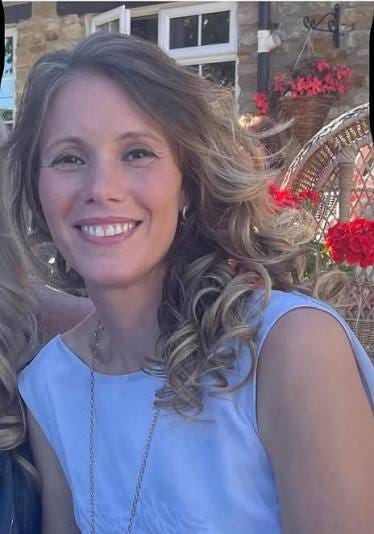
43-year-old Kimberley Thompson
Her husband was standing there, calm and upset at the same time. He was not performing CPR. Around her were the reasons she had died. Two empty packs of co-codamol, the British over-the-counter mix of codeine and acetaminophen. A bottle of gin. A glass bottle shaped like a skull. And propped nearby, two photographs in frames.
The first was Kim and her husband Michael on their wedding day. The second was a montage of pictures of Kim’s sister, who had died by suicide ten years earlier. Brown asked Thompson about the photographs of the woman, and Thompson confirmed it was the patient’s sister. Brown asked where the sister was. Thompson replied, “Where do you think?” “I did not question that further,” Brown told the court.
Brown was not especially troubled by the number of tablets. What moved him toward an overdose was something the husband said: that the skull bottle had been full that evening.
Michael Thompson was fifty-five, a former bouncer and amateur boxer. He told the officers who arrived at 6:05 a.m. that Kim had been tipsy the night before, that they had slept together, and that he had come down thirsty around 5:30 and found her in the middle of her bed, face down. He said he grabbed her arm to wake her.
The paramedic who arrived nineteen minutes after that found her on her back.
Nobody in that house asked why a woman who had decided to end her life would arrange her dead sister’s photographs beside her first. An officer did ask whether Kim had been a heavy drinker. Thompson said the question was harsh.
The police looked at the pills and the bottles and the photographs and saw a woman who had come apart. They comforted her husband, arranged for her body to be taken away, and gave him the all-clear to tidy up.
Nobody opened a murder investigation for three days. It happened then only because Kim’s friends and her family refused, flatly and immediately, to believe a word of it.
They were right. Almost everything in that room had been carried into it by the man who called for the ambulance, including the photographs of her sister.
I have spent most of thirty years looking at scenes like this one, and I keep a database of them. Staged suicides: who built them, out of what, and how long it took anybody to notice. Michael Thompson is case 165.
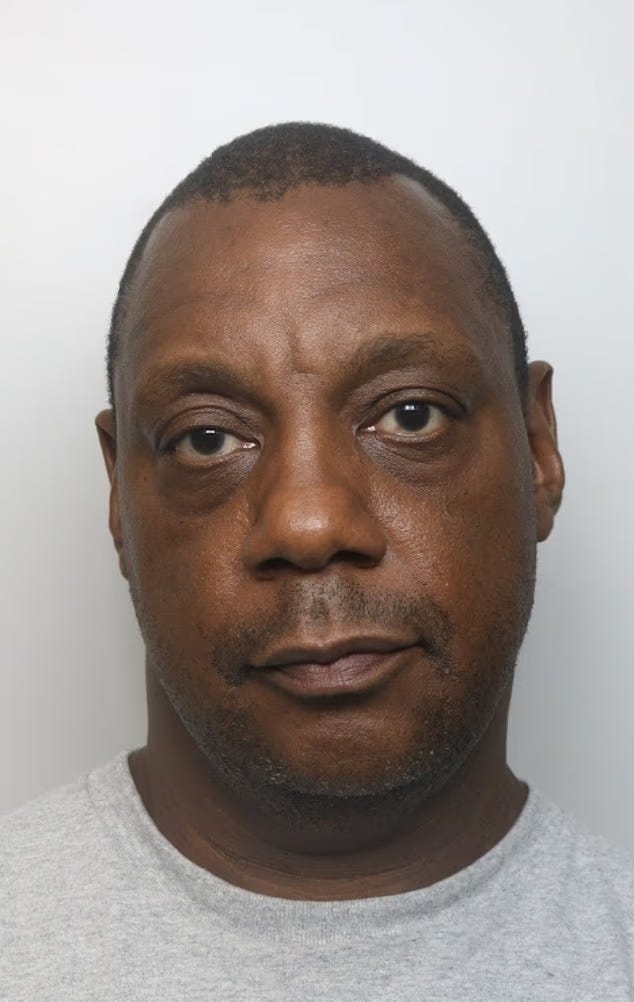
55-year-old Michael Thompson
There are ten common markers for a death like Kim’s. Six come from Bitton and Dayan’s 2019 study of murder scenes staged to conceal the killing of women. The other four were added by Alliance for HOPE International out of their own work re-investigating suspicious domestic violence deaths. In California, since January 2025, all ten are written into the Penal Code:
1. The decedent died prematurely or in an untimely manner.
2. The scene gives the appearance of death due to suicide or accident.
3. One partner wanted to end the relationship.
4. A history of domestic violence that includes coercive control.
5. The decedent is found dead in a home or place of residence.
6. A current or previous partner finds the decedent.
7. A history of domestic violence that includes strangulation or suffocation.
8. The partner, or a child of the decedent or the partner, is the last to see the decedent alive.
9. The partner had control of the scene before law enforcement arrived.
10. The body moved, or the scene or evidence altered.
Kim’s case carried all ten. Six of them were visible to anyone standing in that doorway on the morning of August 9. The other four needed someone to make a phone call or open a file, and no one did that for three days.
Everything She Was Building Arrived in the Same Two Weeks
Her family did not need to be persuaded. They knew within hours, because they had spent the previous two years watching her come back to life, and they knew exactly how much she wanted to be alive.
Her name was Kimberley Bounds. She coached her own daughter at the basketball club. The prosecutor who spent six weeks describing her to a jury settled on two words in her closing: vibrant, and that she worked her socks off for her kids.
She had married Michael Thompson in 2006. They had separated two years before her death and were still in the same house, in separate rooms, while the divorce ground forward.
On the morning of New Year’s Eve 2024, she changed her surname on Facebook from Thompson to Bounds. Three weeks earlier, on December 8, she had unfriended him. She had found a third property to move into and set money aside for it. In the summer she started seeing Nathan Syratt, whom she met at a basketball final he was DJing, and a friend named Colleen told the court it was the happiest she had ever seen her. Her daughter Athena was at college in America, and Kim was arranging a flight out to see her.
Friday, August 8, 2025, was, by every trace it left behind, an ordinary evening. A doorbell camera caught her at 9:10 walking up the driveway and into the house. She video-called Athena in America. She messaged Nathan. At some point she sat and read restaurant reviews, looking at places to eat in her own town.
Her bedroom light went on at 11:58 and off at 12:32.
A woman planning to die does not spend her last evening comparing menus.
The other years explain why nobody outside the house could reach her. A school friend called Danielle Harrison told the jury that Kim had gone from full of life to very thin and frail-looking, a change she placed as far back as 2008. Another friend said Thompson had got into her head. Someone else described what they were watching as a half-life. Kim stopped confiding in people, not because she had nothing to say but because she knew he was reading her phone.
For years she told people that the marks on her face and body came from basketball. She was, conveniently, a woman who played a contact sport.
She had considered going into a shelter and decided against it, because she was frightened of what he would do to her family.
At some point in all of this, Danielle testified that Kim said this to her. If anything ever happens to me, please know it was him.
She said it years before it did.
The Marks Were Never From Basketball
Kim’s childhood friend Annette Collins told the jury that Thompson had threatened to kill her so many times that it just became normal.
A threat only works the first few times. After that, it becomes weather. You stop reporting it for the same reason you stop reporting rain.
They met in 2001, when Kim was nineteen. He already had two children from a previous relationship, and Kim helped raise them. The woman who had given birth to them had died in a bath in Northampton the year before Kim met him.
The injuries came in through the side door of other people’s testimony, one witness at a time, none of them able to give the whole picture because none of them had it.
A colleague named Rosie Williams remembered March 10, 2022, when Kim came into work with a broken nose. She said she would go to the hospital after her meetings. She explained that the nose had not bled, so she would not get black eyes. She said it happened at basketball the weekend before.
A friend described bruises on Kim’s legs, arms and torso, and said Kim told her Thompson had done it. Colleen described being told he had grabbed Kim by the neck and thrown her, and about the day Kim came home from work to find her bed in the garden, smashed up.
The prosecution also told the jury he had head-butted her hard enough to perforate an eardrum.
Then there is Elizabeth Muddiman, who worked with Kim at the county money claims court. She saw bruises on Kim’s neck, chest, and arms. Kim told her that her husband strangled her, that she feared for her breathing, and that she feared he would go further.
Non-fatal strangulation is not one assault among others. In the research on domestic homicide, it functions as a marker. Glass and colleagues, working from Danger Assessment data on 933 women, found that a woman whose partner had previously strangled her had over seven times the odds of later being killed by him. It is also the closest thing there is to a rehearsal. Kim was describing, years in advance, the mechanism of her own death.
Muddiman also gave the jury something else. Kim had once forgotten to end a phone call properly, and Muddiman heard the rest of it. She heard a disturbance. She heard Thompson calling Kim a pathetic c-word, a dirty whore, a narcissist. The judge who sentenced him later noted that while he was saying it, Kim was apologizing to him.
Thompson had an answer for all of it, and his answers are their own kind of evidence. He told police there had been no violence except when Kim drank. She had thrown a bracelet out of an upstairs window and climbed out after it, which was his explanation for how she came to go out of that window. She had been in a car accident. The only time he restrained her was consensually, during sex. She was a pathological liar.
None of the rest of it was violence at all, which is exactly why it worked.
He read her phone, so she stopped telling her friends things. Rosie Williams explained how he got in. Kim’s phone opened on a swipe pattern, and if you held the screen up to the light you could see the marks her finger had left on the glass. He went through the bins. He put recording devices in the house and one in her car, which she eventually found. She kept food, clothes, and a diary at work because he searched her things at home. He bought books about women who play the victim to make men look bad, highlighted passages, and left them where she would find them.
In 2013 she referred herself to the Sunflower Centre in Northampton, said she was being emotionally and physically abused and that her husband had made threats she was taking seriously, and then retracted it.
At his trial thirteen years later, his barrister, Jonas Hankin KC, told the jury that the retraction was evidence that Kim lied.
He had two phones. In court, they were called his everyday phone and his recording phone. Across both, police recovered more than 550 hours of recordings of his wife. Eighty separate days of recording in 2024. Forty-seven more in 2025. A hundred and eight recordings that ran three hours or longer, and twenty-nine that ran eight hours or longer.
One of the files was called “She Got Told.”
She Asked for £65,000. She Was Dead in Eight Days.
He filed in February 2024. The prosecution did not dispute that he wanted the marriage over. But he wanted it to end on terms that left her with nothing, which is different.
They jointly owned two properties, the house on Pinewood Road and a second one with tenants in it. Thompson wanted to keep both and give Kim £40,000 in equity. The third house, the one she had saved for, was the one she was going to move into. She was renting it out in the meantime, to help pay for Athena’s college in America.
On July 25, 2025, she took legal advice, and afterward she changed her mind. Instead of the £40,000, she asked for a third of the second property.
On August 1, a consent order for £65,000 went to the family solicitors, who forwarded it to Thompson.
She was dead on the ninth.
In a voice note, Kim tells a friend she knows things are going to get messy. In another, she says she feels amazingly unsafe in the house on Pinewood Road. She told a friend to expect her at the door, because she might need somewhere to stay. And some months before she died, she told a colleague, Amy Spencer, that her husband had threatened to cut the brakes on her car.
Thompson gave his own account of the money to police after his arrest. Asked about the jump from £40,000 to £65,000, he said he did not know why Kim had changed her mind, that it did not really matter, that he could cover it, that it was not a big deal, and that anyway he saw it as an increase of £25,000.
A man to whom money means nothing does not need to say so four different ways in one interview.
The prosecution’s reading came from his own messages. He was, in Miranda Moore’s phrase, keen to keep any money he felt he owned. She quoted him to the jury on what he thought of Kim’s claim on it. He would rather see her dead, he had said, than give her any money.
There is one more date. On August 11, two days after she died, Kim was booked to go away to a hotel with Nathan. She had not told him. She did not need to. Moore told the jury that Thompson had access to Kim’s phone, and that this was how he found out about the trip she was planning with her new partner.
She had bought a house. She had a settlement in writing. She had a man who missed her, a short break in the calendar, and a daughter to fly out and see. Everything she had spent two years building was scheduled to arrive in the same two weeks, and he knew about it all.
At 1:31 Her Phone Took Two Black Photographs
Almost none of what follows is reconstruction. It comes from timestamps: two phones, a Facebook account, a neighbor’s camera pointed at the street.
At 8:44 that evening, Thompson opened a video of Kim of a sexual nature, taken from her phone on June 3. Between 9:58 and 10:03, while she was downstairs talking to Nathan, he opened another. Around 10:10, while they were still messaging, he opened a third. At 10:28, he opened a video of himself and Kim having sex. He opened it again; the second time it had been edited and zoomed in.
At 11:58, the light in her room came on. The camera that recorded it belonged to a neighbor across the street. She and Nathan were still messaging. Their last exchange ended at 12:03, with both of them saying they missed each other.
At 12:32, the light went off.
At 1:31, two completely black images were captured on Kim’s phone. Nobody has explained them.
At 2:30, a WhatsApp message arrived on Thompson’s phone from Kim’s, saying that she wanted to have sex with him.
That is where the timestamps stop helping, because the Crown’s case was that Kim never sent it. Miranda Moore put the rape and the murder between 12:02 a.m. and 3:30 a.m., and the front of that window sits inside the minute Kim was last known to be alive and typing to somebody. There were four counts on the indictment: murder, rape, and two of perverting the course of justice. The third was manufacturing communications from Kim suggesting that the two of them were married and that she was instigating sex. The jury convicted him of it, unanimously.
His own account came out of his first police interview, three days later. The message meant she wanted him to come down. He found her on the mattress, upright with her legs straight out, which was her way of telling him what she wanted. They had sex. She asked for anal sex, and he was not into it, so he used his finger instead. He left her looking at her phone and went back up to his own room.
Three things are wrong with that.
First, it was not his original account. Asked what had happened, he originally told officers his last contact with his wife was a message of a sexual nature at 2:30. He did not mention going downstairs. He did not mention seeing her. He did not mention sex at all. That came afterward.
The second is the sex act itself, which he volunteered and attributed to her. The prosecution’s case was that Thompson had demanded sex from Kim and performed an unwanted sex act during intercourse to punish her for an affair earlier in the marriage. Her own messages were read to the jury. She said she felt she had no choice. She used the word hate. She said it affected her for days. She did not report it, because she had had an affair and did not believe the police would take her word.
The third came from the woman who had sat next to her at work for fifteen years. Rosie Williams told the jury that after the separation, when Kim was sleeping alone in the small room, Thompson came into it. Asked in what circumstances, Rosie said he had told Kim it was his right to have sex with her, because he had put up with her for so many years. Asked how Kim had looked when she told her this, Rosie said she “looked broken” and that “her eyes just filled with tears.”
He had already told her that consent was a formality. Then a message arrived saying she wanted it.
At 3:32, an hour and two minutes later, a friend request went from Kim’s Facebook account to Michael Thompson’s. They had not been friends on the platform since December 8, 2024.
At 3:35, her relationship status changed to married.
Thirty-two seconds later, inside the same minute, a post went up on her page saying she had been “drinking to much !,” spelled with one o and a space before the exclamation mark.
The first two of those belong to count three, along with the 2:30 message. The third belongs to count four. He was not building one story that night. He was building two. The scene around the mattress was there to explain a death. The friend request, the restored marriage, and the message about wanting sex were there to explain a body that had been raped.
Then the house went quiet for two hours.
At 5:39 a.m., Thompson called 999, the British emergency number. He said he had woken up thirsty, found her face down in the middle of her bed, turned her over and given her CPR and mouth to mouth.
Owen Brown arrived ten minutes later and found her on her back. And at some point while he was in that room, Thompson took his phone out of his pocket and showed it to him.
Brown had no body-worn footage running, so this is his recollection, but he remembered an exchange that read to him like an argument, including a picture of what looked like a hotel booking. He also remembered the last message on it, timed at 2:30 that morning, which Thompson described as graphic.
The first person through the door was shown the evidence before he was shown the body.
Two Things in That Room Had No Job to Do
Everything in that room had a purpose, but not the same one. Some of it was built to be seen by police. Some of it was built to be seen by no one but him.
Start with what was built for the police. The pills. The gin. The skull-shaped vodka bottle. The unprompted remark that it had been full. Miranda Moore told the jury he was setting the suicide scene in almost the first thing he said to the 999 operator. He gave them the story before he gave them the address.
Then there is the call itself.
Before any medical instruction, he asked the operator whether he should move the cars off the drive to make room for the ambulance. She told him to deal with the patient.
She talked him through resuscitation. Lay her on her back, on the floor, kneel beside her. He started counting compressions. He was crying so hard that the operator took over the counting for him. At one point, he can be heard being sick.
Ten minutes after the call, Brown walked in and found Kim on the mattress, covered, head on a pillow. She was never on the floor. Nobody had moved her. When Miranda Moore KC asked whether he saw signs that CPR had been carried out, Brown told the court, “I did not.” Thompson had worked as a bouncer for years, a job that comes with resuscitation training, so he knew what compressions look like and what they are done on. What he produced instead was the sound of them.
I would have left the grief there, as a question the evidence could not answer. The judge who sentenced him did not. She told him the evidence made it clear that he had pretended to do CPR and that he had feigned distress on the phone to the emergency services.
Two separate neighbors heard screaming at different times around the night Kim died. Thompson told police it was foxes, twice. Asked directly whether he had placed the bottles, the packets, and the photographs beside her to make it look like she had harmed herself, he said, “I did not do that, no.”
Now start removing things from the room.
Everything with a job to do goes; the pills, the gin, the bottle, the remark. The message at 2:30, the friend request at 3:32, the status at 3:35. Those last three were not loose ends. They were count three on the indictment, and count three had a purpose as hard-edged as the blister packets, because it manufactured a marriage and a woman asking for sex. The friend request is still the most self-incriminating thing he did that night, the one act that could only have been performed by somebody holding her phone after she had stopped using it. But it was not pointless. He took the risk because it bought him something.
The framed pictures of her dead sister go too. A woman whose sister died by suicide ten years earlier is a woman a detective can imagine following her. Propped beside a body, that montage supplies a reason. The only trouble with it is that it did not live in that room, and neither did the alcohol. Moore put it to the jury directly: the photographs were kept elsewhere in the house, and the bottles had been carried up from where they belonged. Somebody walked through a house in the dark collecting them.
Take all of it out, and two things are left: a photograph of a wedding, and a sentence.
No detective has ever looked at a wedding photograph and thought overdose. It does not suggest despair. It does not supply a history. The obvious objection is that it supplies something else, because he spent the small hours of that morning rebuilding a marriage: a message at 2:30 in her name saying she wanted him, a friend request at 3:32 reversing the unfriending she had made in December, a status changed to married three minutes after that. A wedding photograph propped beside her body fits neatly into that sequence, and it could corroborate the reconciliation the other three things were manufacturing.
I don’t think it works, because a wedding photograph proves a wedding, not a marriage. Theirs was in 2006. Anyone looking at that frame on the morning of August 9, 2025, was looking at evidence of something that had demonstrably ended. He had filed for divorce eighteen months earlier. She had changed her name back on Facebook. She was sleeping on a mattress in the smallest room in the house, a room with no door. The photograph does not argue they were back together. It argues only that they had once not been apart, which is a different claim and corroborates nothing about that night. The status change did that work, and it did it better. The frame was redundant to it.
It is the one object in that room with nothing to do. He carried it in anyway, during the most dangerous hour of his life.
And a suicide does not need a caption. The pills and the bottles were the explanation. Nothing he built that night required a sentence added to it. He wrote one anyway, in her name, on her page, to everyone who knew her.
He had been saying things about Kim for nineteen years.
He called her a narcissist. Their daughter testified to hearing it. A colleague heard it down an open phone line, along with worse. He filed her number in his own phone under Amberley, and when police asked why, he laughed and said it was a reference to Amber Heard. After her death, he told detectives she had been a pathological liar.
And he had already said what the ending would be. Rosie Williams’s evidence was that Thompson claimed Kim needed her supplies, by which he meant sleeping with men in hotels, and that everybody was going to know what she was really like.
Set that beside what he wrote in her name at 3:35 in the morning.
Drinking to much !
It is the same story he had been telling about her for nineteen years, delivered one final time in her own voice, on her own page, to everyone she knew. The staging did not only need police to believe she killed herself. It needed the world to agree that she was the kind of woman who would.
At trial, he did not give evidence and called no witnesses. His defense was dozens of messages and long voice notes in which Kim told him she loved him, read out to the jury over two days by Micalia Williams, the junior of the two defense lawyers. Jonas Hankin KC took the closing. A man who had rebuilt the marriage on her page while she lay dead in the next room spent six weeks running a defense built out of archived affection.
Her friends knew within the hour. They knew the way she typed: the wrong “to,” and a space sitting between the last word and the exclamation mark. Kim did neither. They also knew the claim itself was wrong, and so did her eighteen-year-old daughter, who told the jury that her mother did not drink at home for no reason, that she had spoken to her that evening, and that she had been getting ready for bed.
He had one last thing to say about Kim. Her daughter was in the witness box a year later, correcting him.
The Pathologist Told the Jury He Could Not Be Sure
There was almost nothing on the body.
Dr. Stuart Hamilton, a Home Office-registered forensic pathologist, examined Kim and reported in September 2025. He found no anatomical cause of death. No toxicological cause. No natural cause. What he did find was an area of grazing inside her mouth, midline purple bruising on her left lower lip, abrasions to her face, and defensive injuries to her arms.
His opinion was that in the absence of any alternative, the most plausible cause of death was external airway obstruction. Suffocation. Pressure applied over the mouth and nose.
He was careful about what that opinion was worth. He told the jury it was a process of exclusion, and that he was not claiming this was the only thing that could have happened. Under cross-examination, he agreed that vigorous sexual activity could not be excluded as an explanation for the bruising.
That is an honest witness, and it is also very nearly a defense case. The jury heard that concession and convicted him of rape anyway.
Hankin built his closing on it. He told the jury the prosecution had an evidential void, and that finding a man controlling and coercive is not a substitute for proving he committed murder.
Staging works because smothering a woman leaves less to find than almost any other method of killing her, and because what it does leave can be argued into something else.
Almost none of what convicted him came from a laboratory.
The toxicology came from Victoria Jenkins, a forensic scientist in pharmacology and toxicology, and the most useful thing she established was what Kim had not taken. The Boots maximum strength cold and flu tablets at the scene contain a decongestant as well as acetaminophen, and the decongestant had not been screened for the first time round. On retest, none of it was in her body, which ruled out those tablets. The acetaminophen and codeine that were present came to about seven and a half co-codamol tablets, well below the fatal range. However, how that squares with what was on the floor beside her is the one thing nobody settled in front of the jury: the paramedic described two empty packs, while Jenkins was briefed by police on packets that were only partially empty.
The alcohol came to ten milligrams per hundred milliliters against a drunk-driving limit of eighty, so low that Jenkins said it could have played no part in her death even combined with tablets. She added that alcohol can be produced in a body after death by microorganisms, and that this low a reading was consistent with that; it may not have been due to alcohol. He had already written, in her name, that she had been drinking too much. Beside her were a gin bottle and a vodka bottle that her husband told a paramedic had been full that evening.
Her fingerprints were not on those bottles. His were.
Detectives put the arithmetic to him directly in interview. A healthy woman, no significant drugs, no significant alcohol, dead of suffocation, and only one other person in the house. His answer was a question. “OK, do people not just die? Does that not just happen? I don’t know. Do people suffocate in their sleep, die in their sleep?”
Not everything survived. A glass of green-yellow liquid with sediment in the bottom was in that room and was never seized. The detective who attended admitted on the stand that this was his error. Jenkins accepted under cross-examination that the toxicology screen covers just over a hundred named drugs and is not exhaustive, and that the contents of that glass were never identified and cannot be ruled out as toxic. Whatever was in it is gone.
Miranda Moore put it plainly to the jury. The cover-up, she said, may be the most powerful evidence against him, because the pills and the bottles and the photo frames could not have walked there by themselves.
The Police Told Him He Could Clean Up. So He Did.
Thompson gave his account before the ambulance arrived. Nobody sealed the room. Nobody seized the glassware.
Asked in interview how his fingerprints came to be on the skull-shaped bottle beside her, he said, “Yeah, I cleaned everything. I polished everything. I wiped everything. Moved everything back.” Then he corrected himself mid-sentence: “Because that was what I was told to do. Well, not told to do, was allowed to do.”
“I was told I could clear up,” he said. “Everything was wiped down and put back. It was like a spring clean.”
Asked in his final interview whether he had got rid of evidence, he said, “Evidence like what? What evidence?” The detectives, he said, “came out and saw exactly what I saw and determined it is what it looks like. I never made no decision on what was what. I just did what I was told to do throughout this whole thing.”
By then, he was offering the police their own conclusion back as his alibi. He also told them they did not have enough evidence against him. It wasn’t true, and forensic science had nothing to do with it. Kim’s family and friends were told she had taken her own life, and they refused it immediately. They knew about the hotel on the eleventh, the house, the settlement, the flight to America.
This is the part I have watched most often. Families are not evidence. They are sometimes wrong about the things they feel most certain of, and a good investigator has to hold their certainty at arm’s length. But they know the shape of a life. They know whether a woman who has just bought a house, signed a settlement, and booked a flight to see her daughter was building something or ending it. Most of the cases I have collected did not come apart in a laboratory. They came apart because somebody who knew her would not stop saying the same sentence to people who had already made up their minds.
On August 12, Northamptonshire Police opened a murder investigation and arrested him. He was charged on September 18.
All of that survived. What did not survive was the room.
There is one more thing from the morning of the ninth. At some point that day, before she had been told her sister was dead, Kim’s older sister Dionne had a phone call with Michael Thompson.
He ended it by telling her to have a good day.
If I Ever Leave Him, He Will Kill Me and Get Away With It, As He Did Before
Rhonda Anderson was twenty-nine. She had two children with Michael Thompson, Sasha and Sebastian, who were eight and six. They never married, although witnesses at Kim’s trial referred to her throughout as his first wife.
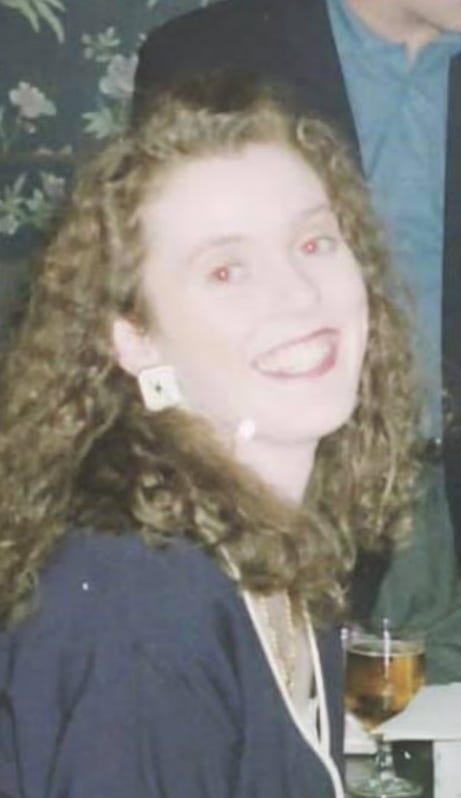
29-year-old Rhonda “Roni” Anderson
On July 8, 2000, she was found dead in the bathtub at her home on the Briar Hill housing estate in Northampton. She had been electrocuted. A plug-in radio was in the water.
At an inquest that October, the coroner, Anne Pember, recorded accidental death. She found that the radio had fallen into the bath and electrocuted her, and that Rhonda had brought a plug-in radio into the bathtub area, which was foolish in the extreme.
That verdict stood for twenty-five years.
The jury that convicted Michael Thompson of murdering his wife never heard a word of it. The Crown applied to put Rhonda’s death before them. Hankin argued it would be difficult to contrive a more prejudicial piece of information to put in front of a jury, and Judge Shant ruled it inadmissible. A reporting restriction kept it out of the press until the verdicts came back.
Before going any further: no one has ever been charged over Rhonda Anderson’s death. Northamptonshire Police opened a fresh murder investigation in December 2025 and arrested Thompson. In July 2026 they concluded there was insufficient evidence and took no action. There has never been a finding of fact against him. The 2000 verdict of accidental death is the only verdict there is.
And it cuts against everything that follows that, according to the Daily Mail, Rhonda’s family did not support the decision to reopen her case and were content that she had died accidentally. Her two children with Thompson, whom Kim helped raise, stayed supportive of their father throughout his trial for murdering her.
So this is not an account of what happened in a bathroom in Briar Hill. It is an account of what Kim Thompson was told about it, and what she came to believe, and what her husband did with it.
Annette Collins told police that when Kim first described what was happening to her, she said that if she ever left, Thompson would kill her. Collins’s statement continued: Kimberley told me that he killed his first wife. Kim told me Michael told her he did it. All I can say is what Kim told me.
Danielle Harrison gave an account that complicates that one. She said people kept telling Kim that Thompson had killed his first wife, and that Kim did not believe it. He had an alibi. He had taken the children swimming on the day Rhonda died.
Kim defended him. For years, when people in Northampton told her what they thought about the woman who died in the bathtub, she pointed to the swimming pool.
Then, sometime between 2012 and 2014, she told Harrison: if anything ever happens to me, it was Thompson. If I ever leave him, he will kill me and get away with it, as he did before.
As he did before.
Another witness said that when Kim tried to leave, Thompson told her, “You know what happened to the last person that tried to do this to me.”
Miranda Moore’s submission set out what the Crown said this amounted to. Not evidence that he killed Rhonda Anderson. Evidence of a serious and deliberate threat, made because Kim was trying to take money out of the separation. Do not leave, do not take my money, and look what happened to the last woman who tried.
The coroner who called Rhonda Anderson foolish in the extreme is Anne Pember, the senior coroner for Northamptonshire. On September 25, 2025, at the Guildhall in Northampton, Anne Pember opened the inquest into the death of Kimberley Jane Thompson of Pinewood Road.
Rhonda Anderson got the inquest. She is the one the coroner called foolish.
What Would Have Happened in California
Those ten are a description of how women in Kim’s position are killed, drawn from the cases where somebody eventually looked hard enough to find out. Six came from Yifat Bitton and Hava Dayan, who studied murder scenes staged to conceal the killing of women and published their findings in 2019. Alliance for HOPE International added four more out of their own work reopening suspicious deaths. For years, that was all the ten were. A finding.
In California, they are now law.
Governor Newsom signed SB 989 on September 27, 2024, and it took effect on January 1, 2025. It is called Joanna’s Law, and it is the first statute in the United States to set standards for investigating a suspicious death where the dead woman had a history of domestic violence. The ten red flags are written into it, at Penal Code section 679.07.
Joanna Hunter died in Solano County in 2011. Her death was ruled a suicide after a brief investigation and no autopsy, despite a documented history of domestic violence. All ten factors were present. It was never investigated as a homicide.
The law does two things with them. Any one red flag is enough for an investigator to order a full autopsy. Three of them, and officers must sit down with the dead woman’s family or her friends and ask about the violence.
Six were in that bedroom on the morning of August 9. A healthy woman dead young. A scene arranged to read as suicide. A death at home. A body found by her partner. A partner who was the last to see her alive. A partner with the run of the room.
The other four were not in the room, which is the point. They were in a solicitor’s file, in a colleague’s memory, in a question nobody asked. That she was divorcing him and had asked for £65,000 eight days earlier. That he kept two phones, one of which the court called his recording phone, and a device in her car. That she had told Elizabeth Muddiman, years before, that he strangled her and that she was frightened he would go further. That the photographs had come from other rooms and the bottles up from downstairs, and his fingerprints were on them and hers were not.
Kim died in Northampton, and no English statute imposes that duty. What eventually opened the murder investigation was her family and her friends refusing, flatly, to accept what they had been told. In California that conversation would have been an obligation on the first morning. In Northampton it took them three days to force it.
Three would have been enough.
Nobody Has Ever Counted the Men Who Did It Twice
Michael Thompson raped his wife, suffocated her, and spent the rest of the night building two stories about it. He was not a criminal mastermind. He left his fingerprints on the bottles. He got the spelling wrong. He restored a marriage on Facebook at 3:35 in the morning with her body two feet away.
He nearly got away with it anyway, and the reason has nothing to do with how clever he was. It is that he was the only other person in the house, so he was the first person to speak, and what the first person says becomes the frame that everyone else works inside. Police arrived at a suicide because they had been told they were coming to one.
This is not rare. It is the ordinary shape of a certain kind of killing. An intimate partner knows the house, knows the medication, knows what her friends would believe, and gets to hand the investigating officer a story before anybody has looked at anything.
Ian Stewart’s first wife Diane collapsed in their garden in Cambridgeshire in 2010. Her death was recorded as sudden unexplained death in epilepsy. Nobody looked again until 2017, when he was convicted of murdering his fiancée Helen Bailey. A neuropathologist then re-examined brain tissue Diane had donated to science and found she had been deprived of oxygen for up to an hour before she died. In 2022 he was convicted of killing her too.
The Home Office pathologist Dr. Nat Cary told that jury what the epilepsy finding really was. It was a diagnosis of exclusion, he said, arrived at by ruling everything else out. And there was a second diagnosis of exclusion that fitted the same evidence just as well: that she had been put into that state by covert means, by smothering, by interference with the mechanics of breathing, or by drugs. It is the phrase Stuart Hamilton used about Kim Thompson, and the phrase Hankin built his closing around.
In 1994 Malcolm Webster drugged his wife Claire Morris, crashed their car, and set it on fire in Aberdeenshire. A fireman found no skid marks and very little damage and thought it deeply suspicious. He was never interviewed. Webster collected more than £200,000 in insurance, moved to New Zealand, and in 1999 drove a second car off a road in Auckland with his second wife sedated beside him. She survived. He was convicted in 2011, seventeen years after the fireman noticed there were no skid marks.
Nobody knows how many men are in that category, because the ones who succeed produce no case file, no conviction, and no data point. The academic literature on staged homicide counts detected cases only. Ferguson and Petherick’s survey says so in its title: an examination of detected homicides staged as suicides. Detection is exactly what a competent stager prevents. No study has ever asked how many stagers had done it before. It is a question worth asking, and I intend to.
That is what the database is for. What I want to know is how many of the men already in it had a first one.
Kim Thompson told a friend, years in advance, that if her husband ever killed her it would look like an accident. She was right. What she could not have predicted is what he did with her sister’s photographs, or that he would use her own Facebook page to tell everyone who loved her that she had been drinking.
He spent nineteen years telling people what Kim Thompson was. The scene in that room was the last thing he had to say on the subject, and for three days it was the official record.
On July 8, 2026, the jury convicted him on all four counts, unanimously, after four days, eleven hours, and thirty-eight minutes.
On July 14, Judge Nirmal Shant KC sentenced him to life with a minimum of thirty-three years for the murder and the two counts of perverting the course of justice, and ten years concurrent for the rape. She said he had made a “concerted attempt to conceal” what he had done and had “set about creating a false scene to fool the police.” “You were literally trying to get away with murder,” she told him. “Your deception continued when you called the emergency services.” And then: “You have shown no remorse. Throughout the trial, you sat in the dock, shaking your head and making audible noises of dissent. And, in the ultimate act of cowardice and contempt, you have refused to come into court to hear from the family of the grief you have caused.”
He was not in the room to hear her say it. Jonas Hankin KC told the court he was “voluntarily absent.”
So he was not there when his eighteen-year-old daughter appeared on a video link from America and called him a “jealous, conniving, narcissistic villain.” He was not there to hear her ask, “How could you do such an evil, selfish, malicious thing? How could you murder the mother of your own children?” He was not there when she said, “A dad is supposed to protect their daughter from pain; instead, you caused the worst pain of my life.” He was not there for the end of it: “I will not let you defeat me; I will show up for her, my mum, and I will continue to make her proud.”
At least six of the eleven jurors who came back to watch were crying.
The judge said she would have the victim impact statements and her sentencing remarks sent to his cell, so that he could “read of the devastation you have wreaked.”
He does not get the last word about Kim. His daughter does, and he will have to read it.
Thank you for reading this issue of The Mind Detective. If this one stayed with you, please pass it to another true-crime-following friend. See you next week.
Sources
Trial and sentencing coverage from the Northampton Chronicle & Echo and the Northamptonshire Telegraph, reported by Katie Wheatley and Logan MacLeod; ITV News Anglia; the BBC; and the NN Journal. Rhonda Anderson's 2000 inquest and the 2025 reinvestigation are drawn from contemporaneous reporting and from the Daily Mail, July 8, 2026. Case 165, Staged Suicide Database.
References
Bitton, Y., & Dayan, H. (2019). “The perfect murder”: An exploratory study of staged murder scenes and concealed femicide. The British Journal of Criminology, 59(5), 1054–1075. https://doi.org/10.1093/bjc/azz015
Ferguson, C., & Petherick, W. (2016). Getting away with murder: An examination of detected homicides staged as suicides. Homicide Studies, 20(1), 3–24. https://doi.org/10.1177/1088767914553099
Glass, N., Laughon, K., Campbell, J., Block, C. R., Hanson, G., Sharps, P. W., & Taliaferro, E. (2008). Non-fatal strangulation is an important risk factor for homicide of women. The Journal of Emergency Medicine, 35(3), 329–335. https://doi.org/10.1016/j.jemermed.2007.02.065
R v Michael Thompson, Nottingham Crown Court, verdicts July 8, 2026, sentenced July 14, 2026 (HHJ Nirmal Shant KC).
Joanna’s Law, SB 989 (Ashby, Rubio, Caballero), signed September 27, 2024, effective January 1, 2025, codified at Cal. Penal Code §§ 679.07, 13519, and Cal. Gov’t Code § 27491. The ten red flags appear at Penal Code § 679.07(b).
If any of this is close to home: in the US, call or text 988, or chat at 988lifeline.org. In the UK, Samaritans is free on 116 123, day or night.
Although the circumstances are sad, I really enjoy reading your writings.
I just don't get why voluntary absentia is even a thing in the UK. Great write-up Joni.