

This article discusses suicide and violent death. If you or someone you know is struggling, call or text 988 to reach the Suicide & Crisis Lifeline.
Sometime before she died, Tasia Fortune told the grandmother of one of her sons that if anybody ever found her dead, she hadn’t done it to herself.

Twenty-nine-year-old Tasia Fortune
She said she would fight. She said she’d fight and fight and fight, and that she’d get as much of his DNA on her as she could.
She was twenty-nine. She had four children, the youngest just a year old. She’d been homeless on and off for years, in a city hundreds of miles from anyone who had known her as a girl.
She had thought about the possibility she might be murdered. And she had worked out what evidence would prove them wrong.
On the night of Monday, August 3, neighbors in the 500 block of Road of Remembrance in west Jackson walked into the backyard of a vacant house and called the police. Officers arrived and, in the words of the department’s statement, located the body of an unidentified Black female at 9:05 p.m. She was hanging from a tree.
On September 10, the state medical examiner ruled her death a homicide. The next day, Jackson police arrested a man and charged him with her murder.
A Backyard on the Road of Remembrance
A week after she was found, an Associated Press photographer stood in that yard and took a picture of what had grown there since. Pinwheels, white flowers, teddy bears, a framed photograph propped in the middle. The kind of small, bright memorial that goes up wherever something terrible has happened to somebody people loved.
A few feet from the flowers were empty chip bags and discarded plastic bottles. The house stood open, and outside lay a tarp, a foam pad, and other debris. The grass hadn’t been cut in a long time.
A tarp and a foam pad by an open door mean the house was vacant only on paper. Somebody had been sleeping there. Tony Anderson, whose brother had been interviewed by detectives, later told NBC News that Fortune had been living at the abandoned home where her body was found. If that is right, she died where she lived.
On August 6, Hinds County coroner Jeramiah Howard identified her. Her body went to the Mississippi State Medical Examiner’s Office, which performed an autopsy on August 11.
Then, for four weeks, nothing.
The Girl Who Ran
Tasia Fortune was born in February 1997 in western Kentucky. Her father is Black and her mother is white, and Tasia identified as Black. Her mother, Christy Spivey, has said she and Tasia’s father faced racism and violence as a couple in Crittenden County before their daughter was born. In that county, in those years, few people embraced a mixed-race child.
As a child, Tasia was placed in foster care with two of her siblings. During high school, she moved among group homes. Spivey describes those years as a long fight with a system that kept separating her children.
Then, at sixteen, Tasia ran. She left for Mississippi with someone she had met in care, and she stayed in and around Jackson for most of her life. She had four children by more than one man. She had no car. She had trouble finding work. She was homeless for long stretches, and she fell into addiction.
More than once, her family tried to bring her home to Kentucky and get her sober. Every time, she went back to Jackson; she wanted to be close to her children.
Her family wrote her obituary, and it says her path wasn’t always easy. There were highs and lows. It also says she was intelligent and talented, skipped her junior year of high school, and was a star cross-country runner. It says she never lost her faith.
Her mother described Tasia as having a laugh you could hear across a room she was usually the center of. She always kept her word, even as a child. She never had much, but she was willing to give whatever she had.
Spivey has also said that one of the men Tasia had children with was verbally and physically abusive to her.
In the last months of her life, Tasia tried to start a cleaning business. In her mother’s words, she was trying to get her life in order.
When a woman who had a hard life dies, the coverage tends to follow a pattern. Everything about her gets flattened into a list of problems with a name attached. Addiction. Homelessness. Four children. A foster care file. Every item on the list is accurate. None of it is the person. And it is the same list that makes a certain kind of death easy to explain away.
She Told Someone What to Look For
Christy Spivey repeated her daughter’s warning in a television interview on September 8, two days before the medical examiner ruled. She didn’t say when Tasia said it or what prompted it.
She wouldn’t be the first person who foresaw her own death. I’ve written before about women who did this. Julie Jensen gave her neighbor a sealed letter and told her to hand it to the police if anything happened. Maya Millete told her sister on a family trip that if anything happened to her, it was Larry. In both cases, the woman was right. Both men were convicted of murder.
What Tasia did is different in one respect. Jensen and Millete named a man. Tasia named a method: someone would make it look like she had done it herself.
Asked about it, her mother said her daughter was a fighter and a survivor.
Four Weeks of Nothing
During those weeks after Tasia died, three things happened to the family, and all three were the same kind of failure.
Christy Spivey couldn’t get answers from the detectives working her daughter’s case. She went around the department and wrote to Jackson City Councilman Kenneth Stokes, who read her letter aloud at a council meeting on September 8. She wrote that the detectives sounded like a prerecorded message, saying the same thing over and over, then going silent. Chief Brackney told the council her department had been in constant contact with her.
Before the family even had confirmation that the dead woman was Tasia, photographs of the scene appeared online. A detective later told the family that someone inside the investigation had taken the images and that the department was trying to find out who posted them. A mother saw that backyard online before anyone told her it was her child.
And there was still no ruling. At that same meeting, Police Chief RaShall Brackney said out loud what the family had believed all along. Her department had been working the case as a homicide from day one, and would keep doing so until the medical examiner told them otherwise. She also said the medical examiner’s office had completed the autopsy four weeks earlier and still hadn’t sent her department the results.
Four weeks is a long time to hold an autopsy in a case that has already drawn letters to a United States Attorney and national television coverage. But the delay may not be a scandal. Deaths like this one are hard to read, and a Mississippi August makes them harder.
What a Body Can Tell You, and When It Quits Talking
A body found hanging from a tree doesn’t tell you what happened to it. People forget it all the time, including people who ought to know better.
Death by hanging and death by strangulation at another person’s hands can leave neck injuries that look fairly similar to the naked eye. So can a third thing: a person dies some other way, and is hung up afterward so the scene tells a story. A photograph of the injuries won’t help you much, either.
The answer is in soft tissue. The pattern and direction of the mark on the neck. Whether the tissue underneath reacted the way living tissue reacts. Bruising in the deep muscles. Injuries to the small structures of the neck. Pinpoint hemorrhages in the eyes and the face. And then what the rest of the body shows about whether there was a struggle: fingernails, knuckles, forearms, knees.
Every one of those findings degrades. The clock runs faster in heat.
Christy Spivey last saw her daughter on July 26. Authorities found Tasia Fortune on August 3. Police haven’t said when she died. What Chief Brackney has said is that Fortune’s body was in various stages of decomposition when it was found.
A body outdoors in a Mississippi August loses the evidence a forensic pathologist most needs. Skin under fingernails is among the first things heat takes. Toxicology in a decomposed body is its own problem. And the scene was a backyard with high grass, foot traffic, and a house standing open.
Chief Brackney has spoken carefully about this case. She has repeatedly described her daughter as having been found in a hanging position. Not hanged. Not that she hanged herself. In a hanging position. That’s a pathologist’s sentence coming out of a police chief’s mouth, describing what the officers saw. It doesn’t say what happened.
On the night of Thursday, September 10, the medical examiner classified the death as a homicide. It still hasn’t released the cause of death. Brackney told CNN that releasing more information would put her investigators at a disadvantage. That’s ordinary practice and probably correct. It also means that until September 14, nobody outside the investigation knew anything about how Tasia Fortune was killed.
The Examination Nobody Ordered
When the body can't tell investigators whether a woman killed herself or was killed, families and courts sometimes call someone like me. The work is called a psychological autopsy. I don't examine her body. I examine her life: who she talked to, what she was worried about, what she was planning, and whether anything in her last weeks points toward suicide or away from it.
The procedure isn’t mysterious. You reconstruct the person. You talk to everyone who saw her in the last weeks and months. You pull treatment records, if any exist. You read her messages. You build a timeline of mood and stress and contact out of what people actually observed, and then you give an opinion about manner of death.
That opinion is only as good as the record the dead person left behind.
I was asked to do one years ago on a woman who had moved to a new city a few months before she died. It was hard. I could talk to her coworkers, and they knew her, but they weren’t the people she confided in. What saved it was that she called her family regularly, so I could at least get a long-distance picture of who she was and how she’d been doing. Without something like that, there’s nothing to measure the physical evidence against.
So what would I have known if someone had handed me Tasia Fortune?
That opinion is only as good as what you can find.
I was asked to do one years ago on a woman who had moved to a new city a few months before she died. It was hard. I could talk to her coworkers, and they knew her, but they weren’t the people she confided in. What saved it was that she called her family regularly, so I could at least get a long-distance picture of who she was and how she’d been doing.
So what would I have had if someone had handed me Tasia Fortune?
I’d start with her mom. She saw her in Kentucky on July 26, eight days before she was found, and has said Tasia was better than she’d seen her in a long time. After that, there’s very little. Christy Spivey doesn’t know where her daughter was living when she died. No fixed address. No employer. No doctor or counselor anyone has mentioned.
But a woman who has been homeless for years still leaves a record. It’s scattered across a dozen offices instead of held by a few people who knew her well.
I’d look at the paperwork. Emergency room and ambulance records, which often note whether someone was intoxicated, injured, or talking about wanting to die. Shelter and outreach logs. Jail intake screenings, which ask about suicide directly. Child welfare files, where caseworkers write down a mother’s visits and behavior over months. Her phone, which would show who she talked to and when she stopped. If she passed through any of those systems, and most people who are homeless for years have, somebody wrote something down.
Then the people. The caregivers raising her children, who saw her as a mother. Her sister. The relatives who saw her at the end of July. Anyone she talked to about the cleaning business. And the hardest group to reach: the people she slept near and used with, who were likely the last to see her and the least likely to talk to someone like me.
Every one of those accounts would need checking against the others, because some of those people would have reasons to shade what they said. In a death that might be a homicide, one of the people you interview could be the person who killed her.
It could be done. It would take subpoenas, releases from her family, months of work, and someone willing to track down people who don’t want to be found. In nearly thirty years, nobody has ever asked me to do one under conditions like these.
The harder question is who would order it.
Psychological autopsies get ordered when someone has a reason to pay for one. A family fighting a suicide ruling. A life insurance company deciding whether a suicide clause applies. A prosecutor answering a defense claim that the victim killed herself, or the defense attorney making that claim. Now and then, a medical examiner who can’t settle a death any other way.
Tasia Fortune had none of that behind her. Her family had to raise money online to bury her. Nobody has mentioned an insurance policy. And the police, by the chief’s account, were working her death as a homicide from the start, so nobody on their side needed a second opinion about whether she had killed herself.
In nearly thirty years, nobody has ever asked me to do one under conditions like these. It isn’t because it can’t be done. It’s because nobody who could order one needed to know.
That may change. If Ratliff's defense argues she killed herself, someone will finally have a reason to find out who she was.
The “Less-Dead”
Criminologist Steven Egger spent years asking why some serial killers went uncaught for so long. His answer had less to do with the killers than with the people they chose.
He called them the “less-dead”: people the society around them had stopped counting long before anyone killed them. Sex workers. The homeless. Runaways. The very poor. Older women living alone. When they disappear, nobody files a missing-persons report, because nobody is positioned to notice they’re gone.
His point was that police respond to pressure, that pressure isn’t evenly distributed, and that offenders work this out.
Criminologists mostly apply the concept to serial murder. I think it explains something about single homicides that we’ve been slower to admit. Anyone who’s spent more than a minute in forensic work knows that all homicide victims are not treated equally.
A woman with Tasia Fortune’s history, found hanging behind a vacant house, is an easy suicide ruling. It’s easy to make the story fit. She used drugs. She’d been homeless. She had a childhood that would break most people. It’s not hard to fill in the blanks.
So the man who kills a woman in her situation doesn’t have to be clever. He doesn’t need forensic knowledge or a plan worthy of a television episode. He needs her life to have already written his alibi, and the more damaged she was, the less work he has to do.
Those cases exist. I have a file of them. Women found days or weeks after they died, in the water, in wooded lots, in their own bedrooms. By the time a pathologist gets to them, there isn’t enough left to tell one manner of death from another. Those cases end in an evidence-tampering charge, or they end nowhere.
Tasia Fortune was found somewhere in between. It took the state medical examiner from August 11 to September 10 to classify her death. When it came, the classification was homicide. Nobody takes four weeks to answer an easy question.
The Man in Court the Next Day
Terence Anderson is sixty-five. On August 4, the day after Tasia Fortune was found, he appeared in Jackson Municipal Court on an unrelated charge of being a felon in possession of a firearm. A judge set his bond at $250,000. During that proceeding, detectives said they had interviewed Anderson about Fortune’s death and that he had acknowledged arguing with her. He denied any involvement.
Anderson and Fortune had a five-year-old son who lived with Anderson. His brother, Tony Anderson, told NBC News he doesn’t believe Terence had anything to do with her death. “Sometimes they’ll have a few occasions where they may get into it or whatever, but that was about it,” he said.
Anderson remains in custody on the weapons charge and has never been charged in Fortune’s death. After Ratliff’s arrest, Chief Brackney said her department had never named anyone a person of interest. On September 14, Tony Anderson told NBC News what the past six weeks had cost his brother. “This just about ruined his life,” he said. “He hasn’t been able to work; people thinking you done it. His little son worried about him.”
The record now contains three things. A woman with addiction and homelessness in every story written about her; a man interviewed about her death who was in court the next day on a weapons charge. A vacant house where somebody had been sleeping.
Everybody in the vicinity of this death had a file.
That doesn’t tell you what kind of people they were. Poor people collect paperwork. Live without money in a city like Jackson long enough and something of yours ends up on a docket somewhere. It is also how a death gets closed fast. When everybody involved already has paperwork, a suicide ruling is easy to believe.
What the Country Saw, and What Her Mother Saw
A Black woman found hanging from a tree in Mississippi has a history.
On August 5, two days after Tasia was found, Jackson City Councilman Kenneth Stokes wrote to United States Attorney Baxter Kruger and to both of Mississippi's senators asking for federal involvement. He invoked Emmett Till by name, and he was clear about why: the state’s history of racial violence and the conflicting accounts families have been handed over the years about what happened to their people.
“It’s too many different stories out here,” he told the Clarion-Ledger. In that letter, written August 5, two days after she was found, he called Tasia Fortune a murder victim. There was no ruling yet, no cause of death, no arrest, and no public evidence of any kind. Five weeks later, the medical examiner agreed.
He turned out to be right, though not because of any evidence.
Robert Luckett, a historian at Jackson State University, told Mississippi Today that the national attention makes sense whether or not this particular death turns out to have anything to do with race. “It’s a reputation that we’ve earned in the state due to the very real nature of racialized violence,” he said. Fortune’s death also arrived less than a year after two other Mississippi hanging deaths that drew scrutiny and were ruled suicides. Demartravion “Trey” Reed, a Black student, was found hanging on the Delta State University campus in Cleveland in September 2025, and his family contested the finding and sought an independent autopsy. Cory Zukatis, a homeless white man in his thirties, was found in Vicksburg, and the state medical examiner determined that he died by suicide.
The pressure has continued since. Representatives Yvette Clarke, Ayanna Pressley, and colleagues wrote to the Justice Department and the FBI. They asked for a thorough, transparent, and comprehensive investigation into what they called the numerous incidents of Black people found hanging across the country. They said federal inaction would amount to complicity.
So that was the national story. When Tasia was first found, it was a reasonable story to tell. Then Tasia Fortune’s mother told a different one.
Christy Spivey has said to Mississippi Today and ABC News that she doesn’t believe her daughter was killed for being Black. “I really don’t feel like it was a racial crime,” she said. “I think that this was more of a personal crime, but I definitely understand the fears.”
Spivey is a white woman who raised a Black daughter in western Kentucky in the 1990s. She isn’t reading Mississippi from a distance. She knows what racial violence looks like up close. And she is still telling people to look somewhere else.
She has been just as consistent in saying that her daughter didn’t commit suicide. “I know my daughter, and she didn’t do this to herself.”
The scrutiny that kept this case alive came from a history her own mother doesn’t believe explains her death. The letters to Washington, the cameras, and the council meeting where the chief finally said the word homicide all came from what the image of a Black woman hanging from a Mississippi tree means to this country. And that pressure is very likely why a homeless woman with an addiction history received weeks of forensic attention and a homicide ruling instead of a quick ruling and a closed file.
A Black Cable Cord
On the morning of Monday, September 14, Jarques Ratliff, a 51-year-old Jackson man known as “Jock,” appeared in Jackson Municipal Court in a red jumpsuit. He was formally charged with Tasia’s murder and pleaded not guilty. His attorney, Toney Baldwin, argued that his client wasn’t a flight risk and was gainfully employed. A law enforcement official at the hearing said Ratliff was a danger to the citizens of Jackson. Judge Taurean Buchanan ordered him held without bond.
Investigators told the court he had tried to hide in a car the day he was arrested. Officers finally picked him up as he walked down Capitol Street.
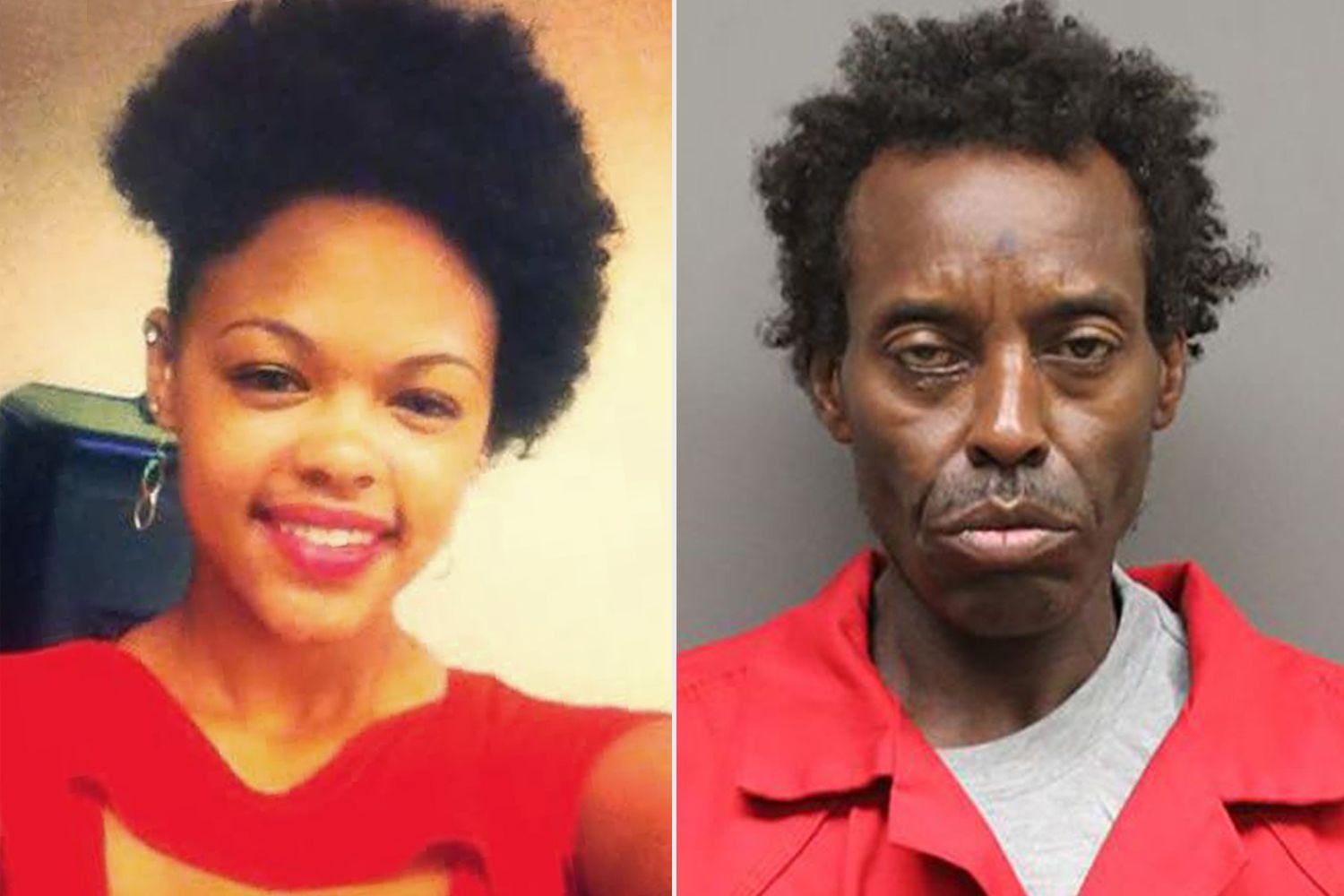
twenty-nine-year-old Tasia Fortune and fifty-one-year-old Jarques Ratliff
Outside the courthouse, Baldwin asked the press and the public not to judge the case before it was tried. “A charge is just merely an accusation,” he said. “It’s not a conviction. We look forward to having our day where we present the full picture.” He is right about that.
And for the first time, the state said how it believes Tasia Fortune died. Prosecutors allege she was hanged with a black cable cord. An affidavit obtained by WAPT accuses Ratliff of using that cord to hang her from the tree.
Hans Gross, the Austrian magistrate whose manual essentially founded modern criminal investigation, warned about this more than a century ago. A killer won’t hang up a person he shot or beat, because the traces are too obvious. He hangs the ones he poisoned or strangled.
The cord also helps explain the delay. A woman suspended from a tree by a cord and a woman who hanged herself produce neck findings that overlap. The features that separate them are the ones a Mississippi August erodes fastest. Whatever the pathologist eventually found, it wasn’t obvious on August 11, or for weeks afterward.
Prosecutors told the court Ratliff had prior charges of grand larceny and cocaine possession, and several thousand dollars in unpaid traffic fines. Mississippi Today found no convictions for him in the state’s electronic court records. None of those charges involved violence.
Brackney said her investigators had interviewed nearly fifteen people. She said Ratliff had an association with Fortune, although she didn’t say what kind. She said the arrest is an important development, that the case remains active, and that additional arrests are pending. “Tasia and her children deserve nothing less,” she said.
Christy Spivey learned about the arrest from the police. “I just started crying and told them thank you, thank you, thank you,” she said. She also said nobody has told her a motive, that she didn’t recognize the name of the man they arrested, and that police wouldn’t tell her whether DNA led them to him. She has been asking her daughter’s friends whether they know him.
“We still don’t have a lot of answers,” she said.
Ratliff is due back in court on September 25.
Whose Death Gets Looked at Twice
I’ve spent years building a database of homicides staged to look like suicides, and the thing that still surprises me is how bad the staging usually is. The rope. The fake note. The history of domestic violence. The position of the body. The frantic call to 911. Most of it wouldn’t survive a serious look.
So what often determines whether these cases get a serious look is who the victim was. A woman with a job, a mortgage, and no psychiatric history gets a detective. A woman who used drugs and slept where she could gets a determination.
Tasia Fortune got the detective. Four weeks of a medical examiner’s attention, a homicide ruling, two search warrants, nearly fifteen interviews, an arrest. She got all of it because a photograph of a Black woman hanging from a tree in Mississippi made a great many people who’d never heard her name refuse to let it go.
Her mother doesn’t think race is why she died. But this time, it may be why she got the attention it deserved.
If you're thinking about suicide, or worried about someone who might be, call or text 988 or chat at 988lifeline.org, any time. If you're in immediate danger, call 911. If you're afraid of a partner, the National Domestic Violence Hotline is available at 1-800-799-7233, or text START to 88788.
As always, thank you for reading this issue of The Mind Detective. If you enjoyed this article, please share it with one true-crime-following friend. See you next week!
References
ABC News. (2026, August 10). “She did not do this to herself”: Mother says family “devastated” after woman found hanging in Mississippi. https://abcnews.com/US/mother-black-woman-found-hanging-mississippi/story?id=135497051
Associated Press. (2026, September 11). Jackson, Mississippi police arrest man in homicide of Tasia Fortune, Black woman found hanging from tree. https://abc7.com/post/jackson-mississippi-police-arrest-man-homicide-tasia-fortune-black-woman-found-hanging-tree/19821475/
Bates, S., & Tang, T. (2026, August 11). What we know about the death of Tasia Fortune in Jackson. The Patriot-News, U2.
CBS News Pittsburgh. (2013, August 15). Boyfriend arrested in connection with Etna woman’s death.
CNN. (2026, September 11). Mississippi police make arrest in Tasia Fortune case after medical examiner rules death a homicide. https://www.cnn.com/2026/09/11/us/tasia-fortune-homicide
CNN. (2026, September 14). Man charged in Tasia Fortune’s death pleads not guilty, is denied bond. https://www.cnn.com/2026/09/14/us/tasia-fortune-homicide-wwk
Commonwealth v. Dinino, No. CP-02-CR-0012854-2013 (Pa. Ct. Com. Pl. Allegheny County Mar. 21, 2014).
Ding, J., Hall, K., & Whittle, P. (2026, September 12). Police say more arrests coming in death of Mississippi woman found hanging from tree—Associated Press.
Drape, C. (2026, August 14). Jackson councilman wants federal help in case of woman hanging in tree. Clarion-Ledger, A1.
Egger, S. A. (2002). The killers among us: An examination of serial murder and its investigation (2nd ed.). Prentice Hall.
Ferguson, C. (2011). The defects of the situation: An examination of staged crime scenes [Doctoral dissertation, Bond University].
Ferguson, C., & Petherick, W. (2016). Getting away with murder: An examination of detected homicides staged as suicides. Homicide Studies, 20(1), 3-24. https://doi.org/10.1177/1088767914553099
Fields, C. (2026, September 11). Jackson police provide major update in death of Tasia Fortune. WLBT.
Gates, S. (2026, August 14). Tasia Fortune’s troubled life leaves her family grieving, and waiting, as police investigate her death. Mississippi Today. https://mississippitoday.org/2026/08/14/tasia-fortune-death-grieving-family/
Gross, H. (1934). Criminal investigation: A practical textbook for magistrates, police officers and lawyers (3rd ed., J. Adam & J. C. Adam, Trans.). Sweet & Maxwell.
Mississippi Today. (2026, September 9). Jackson PD calls Tasia Fortune’s death a homicide but still awaits autopsy. https://mississippitoday.org/2026/09/09/tasia-fortune-death-homicide-autopsy/
Mississippi Today. (2026, September 14). Jackson man pleads not guilty in Tasia Fortune killing. https://mississippitoday.org/2026/09/14/tasia-fortune-hanging-jackson-ratliff/
National Institute of Mental Health. (2025). Suicide. https://www.nimh.nih.gov/health/statistics/suicide
NBC News. (2026, August 10). Jackson, Mississippi, hanging: Person of interest questioned in Tasia Fortune death. https://www.nbcnews.com/news/us-news/jackson-mississippi-hanging-person-interest-questioned-tasia-fortune-d-rcna591686
NBC News. (2026, September 14). Man pleads not guilty, denied bond for charges in Tasia Fortune’s murder. https://www.nbcnews.com/news/us-news/man-pleads-not-guilty-denied-bond-charges-tasia-fortunes-murder-rcna597669
Pittman, A. (2026, September 11). Arrest made in Tasia Fortune hanging death, Jackson police say. Mississippi Free Press. https://www.mississippifreepress.org/arrest-made-in-the-fortune-hanging-death-after-homicide-ruling-jackson-police-say/
Times of San Diego. (2026, July 20). Sentencing set for Larry Millete, convicted of murder in wife’s 2021 disappearance. https://timesofsandiego.com/crime/2026/07/20/sentencing-set-larry-millete-murder-missing-wife/
Tucker Funeral Home. (2026, August). Obituary of Tasia Sidea Fortune. Central City, Kentucky.
WJTV. (2026, September 8). Mother demands answers after Tasia Fortune’s death. https://www.wjtv.com/news/local-news/mother-demands-answers-after-tasia-fortunes-death/
WPXI. (2013, August 15). Police: Etna man strangled girlfriend. https://www.wpxi.com/news/woman-31-found-dead-etna-porch-1-person-questioned/289680463
Excellent article. Well reserched and a great read. A tragic but important topic brought to life. Miriam Orwin your Australian fan.
The same moment I read the headline of this story I said to my husband that she was murdered. He looked at me and I said the only way it could possibly be suicide is if this young woman wanted it to appear to be murder. In Mississippi I cannot imagine any Black woman would commit suicide in that manner for any other reason.